Wizz’s XLRation
As Wizz Air becomes the first low-cost airline to take delivery of an Airbus A321XLR, Robert Veitch travels to Hamburg to witness the handover ceremony
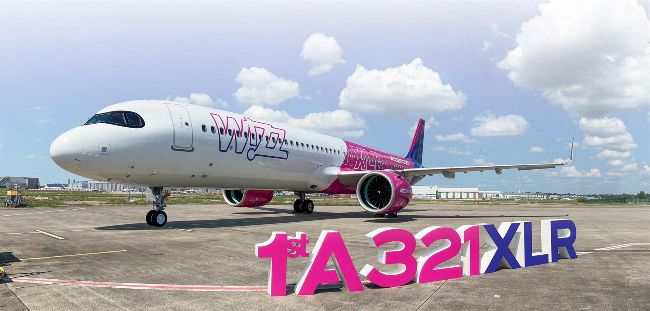
As well as being the airline’s maiden XLR and the first of the type to be UK-based, it is also the first XLR delivered to a low-cost carrier and the first powered by Pratt & Whitney GTF engines
ALL IMAGES KEY-ROBERT VEITCH
The arrival of the first Airbus A321XLR in the Wizz Air fleet offers an intriguing proposition: that low-cost carriers can finally fly long-haul routes in a way that has never before been possible. One might think this could finally be the spark for budget airlines to look west and transatlantic for expansion. In time they might, but for now the smart money is heading east and southeast to burgeoning markets in the Middle East and Indian subcontinent. In these territories, route and airport capacity is growing and the opportunity to fly is becoming increasingly affordable to an ever-expanding number of people.
The XLR was launched at the 2019 Paris Air Show and the response was enthusiastic, with 14 aircraft ordered during the first week. By the end of 2024, the order book had swelled to 516 aircraft from 25 legacy and low-cost customers around the world,
Airbus claims it burns 30% less fuel per seat than previous generation competitor aircraft and flies at roughly half the trip cost of modern widebodies. But we have been here before in the 1990s, when extended-range twin-engine operations (ETOPS) Boeing 757s operated long, thin transatlantic routes, offering a range of up to 3,900nm.
Across its various iterations, the A321 has retained the same basic dimensions: 146ft from nose to tail, an 117ft 5in wingspan and 38ft 7in in height. The real evolution has been its scope to eat miles. Lufthansa’s first example, D-AIRA (c/n 458), which is still in service with the airline, began its flying career in January 1994 and offered a range of 2,300nm.