OF DEVILS AND DETAILS
A quarter of a century since the loss of Concorde, few appreciate the range of factors that conspired to cause the crash. Robin Evans examines the chain of events of that fateful day on July 25, 2000
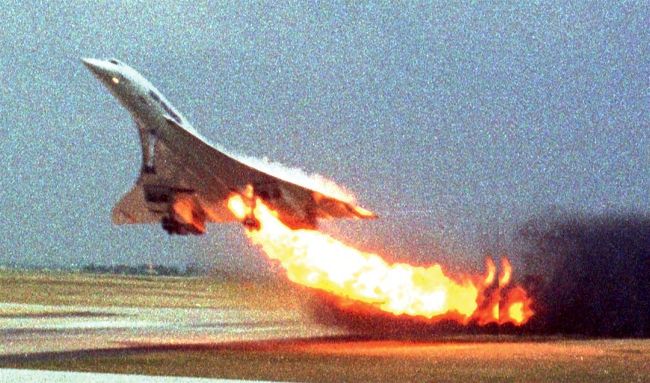
One of the few photos of Air France Flight 4590 after take-off from Paris/ Charles de Gaulle
ASSOCIATED PRESS/ ALAMY STOCK PHOTO
Concorde had always polarised. The great swan and white elephant divided haves and have-nots, representing technical and aesthetic triumph. Developed at great public cost then given away, it was costly to run but lucratively profitable. With use dictated politically, the design was governed by brutal physics endured or exploited, pioneering digital engine controls, fly-by-wire and carbon brakes. Optimised for greatest height and speed, Concorde’s Achilles’ Heel bared itself at the opposite end of the flight envelope for Air France Flight 4590 on July 25, 2000.
A day unravelling
Concorde attracted an elite cadre. Air France lifers in their 50s, Captain Christian Marty, First Officer Jean Marcot and Flight Engineer Gilles Jardinaud had all flown multiple types, exceeding 10,000 total hours each, with between 300 and 2,700 on type. Marty was particularly notable, having windsurfed the Atlantic between Senegal and French Guiana in 1982, refusing his support crew to sleep strapped to his board. A 32-year Air France veteran of types including the Boeing 727, 737, Airbus A300, A320 and A340, he was an explorer with a philosophical, driven nature, preferring to calculate his challenges – until they chose him.
The third production Concorde, F-BTSC (c/n 203) was leased by Air France from Aérospatiale in 1976 as a base model. It was subsequently upgraded and bought for a nominal one franc in 1980, becoming Air France’s heaviest example – weighing around a tonne more than its lightest and newest airframe, F-BTSD (c/n 213). Concorde’s operation was unique in that it was intense, but the airframes were lower-timed than other fleets. F-BTSC accrued 11,989 hours in 4,873 cycles.
It also had a large engineering input with the hourly cost being significantly more than conventional aeroplanes. Over July 17-18, the left main gear bogie had been replaced to rectify a defect on the tyre under-inflation detection system, a procedure not previously carried out by Air France. The aircraft had since made four flights, with minor components replaced overnight.
Without an equivalent fleet and emphasis on dispatch reliability, a standby spare was kept should an engineering defect crop up, with F-BTSC being assigned overnight. Additional work to replace the pneumatic motor of an exhaust bucket had delayed 100 predominantly German passengers awaiting a New York/JFK charter. To reconcile fuelling and loading – always a fine balance – the crew took control of the pre-flight from the dispatcher, pushing back an hour late.
Local procedure had become loading double the standard tonne of taxi fuel, even though only 800kg was burned as they taxied to depart on the full length of Runway 26R at Paris/ Charles de Gaulle. Accordingly, flight engineer Jardinaud restored a CG (centre of gravity) to the 54% aft limit by pumping fuel forward from Tank 11 in the tail to Feed Tanks 1-4.
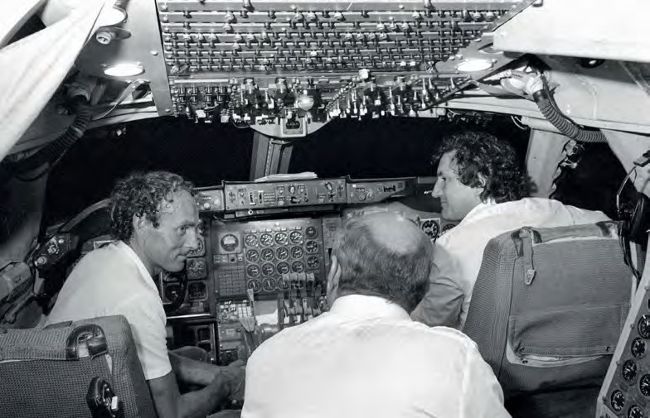
Christian Marty (left) was the captain of Flight 4590. He is seen here in France in 1982
JEAN-CLAUDE FRANCOLON/GAMMA-RAPHO VIA GETTY IMAGES
The big bang
Take-off clearance was given at 16:42:17 local time, nobody commenting on the reported tailwind. All was normal until six seconds after the 150kt V1, the speed at which take-off could not be rejected for insufficient runway remaining. Inside three seconds, the engine ‘go lights’ blinked out indicating incorrect thrust, the cockpit voice recorder (CVR) later indicated a single, unidentified sound and change in background noise. Jardinaud called “Stop!” while air traffic controller Gilles Logelin transmitted: “Concorde four five nine zero, you have flames behind you.” Engines 1 and 2 surged, unbeknown to the crew from ingesting hot gas and kerosene, the former also from structural fragments. The thrust loss was slight for Engine 1 and severe for Engine 2, causing a left yaw described as a “… violent kick in lateral acceleration.” Waiting to cross in the distance was an Air France Boeing 747, which had recently landed on the parallel runway. It carried French president Jacques Chirac but more significantly, businessman Toshihiko Sato, who took the only close-up pictures.