Too big to fail?
In an extract from the recently published Airlines of the Past bookazine, Ben Dunnell traces the story of Trans World Airlines. Over its 70-year history, TWA became one of the most iconic names in American aviation, shaped by a cast of influential and often controversial figures including Charles Lindbergh, Howard Hughes and Carl Icahn. But despite its storied past, the airline eventually succumbed to mounting competition from rival US majors as the 20th century drew to a close
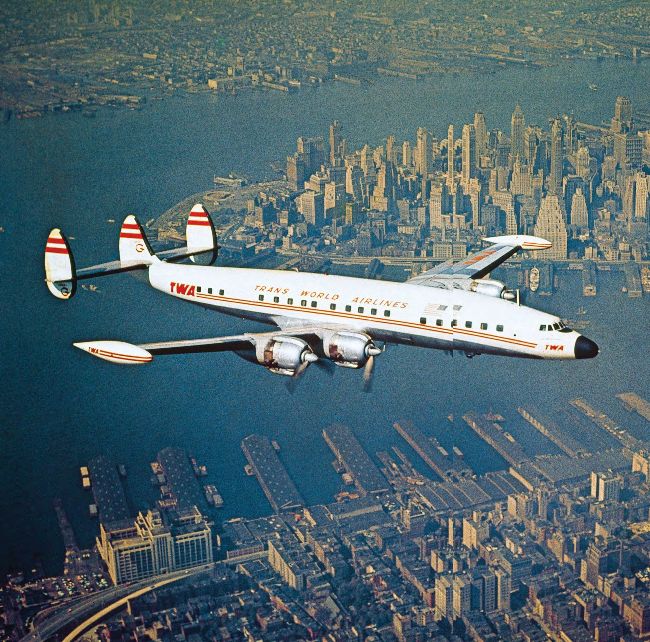
There can be few more glorious spectacles in commercial aviation: TWA L-1049G Super Constellation N7102C over New York City
LOCKHEED MARTIN
The 71 years between 1930 and 2001 were a colourful and often spectacular period in US airline history. Dominated by a powerful trio – United, American and TWA – all of which had been around since the industry’s earliest days, it was TWA, the smallest of the three, that often seemed the most precarious. Yet despite its not infrequent bouts of financial frailty, nobody really expected it to go under.
Yet, in late 2001, Harry Levins of the St Louis Post-Dispatch newspaper wrote: “Now the airline that couldn’t die has done just that.” Lamenting the demise of a major local employer, Levins added: “You’d think that an airline that survived Howard Hughes could survive anything.”
Well, yes, but the Hughes era can be seen as a golden age for TWA, especially as it also featured the much-loved Lockheed Constellation whose design he’d inspired. Sure, the airline eventually had to go to court to rid itself of a man often described as ‘eccentric’ or ‘reclusive’, but there was worse to follow: vicious battles for control, bankruptcies, hijackings and the tragic loss of flight 800.
Though TWA wasn’t founded until July 1930, its origins trace back to the Air Mail Act of 1925, which opened mail routes to private operators. One early contract – linking Salt Lake City and Los Angeles – went to Western Air Express (WEA), which began scheduled passenger flights in 1926 using two-seat Douglas M-4biplanes. At the time, trains were more reliable and comfortable, but Charles Lindbergh’s 1927 solo flight across the Atlantic sparked a surge in public interest in aviation. New airlines quickly emerged, including Transcontinental Air Transport (TAT), launched in 1928 with Lindbergh’s help. TAT’s cross-country service debuted in 1929, combining air hops with rail segments to cut journey times to 48 hours.
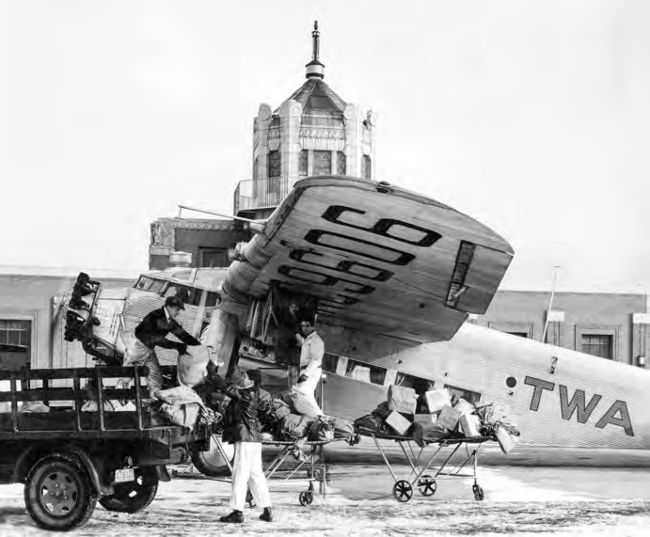
Transcontinental and Western Air employees loading air mail into Ford 5-AT-B Tri-Motor NC9606 at Kansas City Municipal Airport
KANSAS CITY PUBLIC LIBRARY
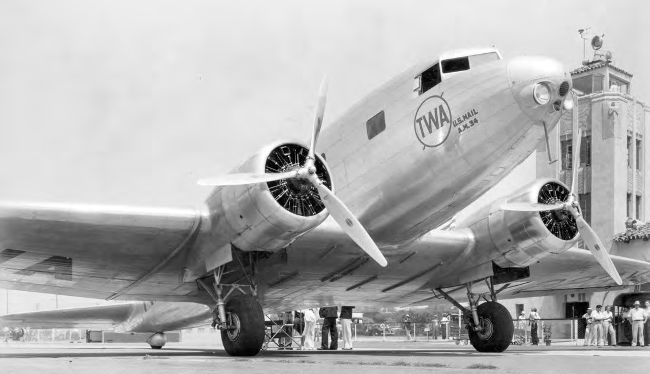
The sole Douglas DC-1, NC223Y, at California’s Grand Central Air Terminal in 1934
KEY COLLECTION
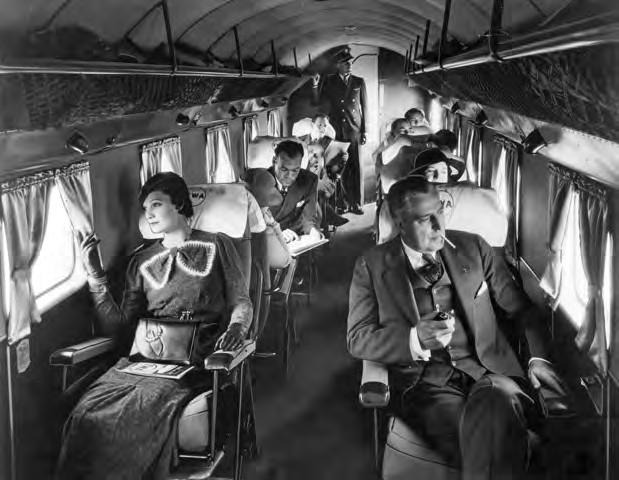
A TWA publicity shot of the Douglas DC-1’s interior, a spacious and refined cabin for a type in its class
KEY COLLECTION
In 1930, WEA acquired Standard Air Lines, founded by Jack Frye, and further consolidation followed under the new Air Mail Act. Postmaster General Walter Folger Brown pushed for a streamlined, stronger airline industry – often forcing mergers to achieve it. When WEA and TAT merged in July 1930, Transcontinental and Western Air (TWA) was born. Brown then assigned the nation’s three transcontinental mail routes: the northern went to United, the southern to American, and the central to TWA.
Douglas to the rescue
In October 1930, TWA offered passengers the first scheduled transcontinental US air service: the Lindbergh Route. It took 36 hours and initially involved an overnight stop at Kansas City. Later, by eliminating the stop, the time shrank to 24 hours. But the airline was losing money at the rate of $200,000 a month, and a crash involving one of its Fokker F.XA tri-motors in which all on board were killed generated further adverse publicity. The accident prompted the government to demand the inspection of all airliners with wooden structures. To avoid this, Frye issued a specification for a new all-metal airliner able to carry 12 passengers and cruise at 150mph over at least 1,000 miles. Only Donald Douglas responded to the challenge and had to persuade Frye that his twin-engined DC-1 could meet his requirements. It first flew in July 1933, although it was the 14-passenger DC-2, in effect the production model, which was to go into service with TWA.