The tale of TUI
The airline division of the mighty TUI travel group currently comprises five main carriers. But how this quintuplet came about was a complex and sometimes chaotic tale of consolidation and collapse, as Lee Cross uncovers

Today, TUI Airways, the UK arm of the mammoth TUI AG, is the largest carrier in the group with a 69-strong fleet
The year is 1961, and British travel industry veteran Ted Langton had watched in horror as several independent airlines employed to carry passengers on his Universal Sky Tours package holidays collapsed.
With the help of aviation consultant John Ernest Derek ‘Jed’ Williams, Langton decided to eliminate the middleman and establish his own airline. Three Lockheed L-049 Constellations – G-ARVP (c/n 1967), G-AHEN (c/n 1980) and G-ARXE (c/n 1965) – were sourced from El Al and converted into a single-class, 82-seat layout. With the UK tightening its ties to the continent and membership of the European single market seeming imminent, the pan-European sounding name Euravia was chosen. Victor Papa operated the maiden sortie on May 5, 1962, positioning to Manchester from its Luton Airport base, where it flew to Perpignan and on to Palma.
Expansion saw additional ‘Connies’ added to the fleet, along with new routes opening from Birmingham, Cardiff and Newcastle. Just three months after its launch, Euravia took over the UK’s biggest charter airline, Skyways Limited, including its fleet of Constellations and Avro 685 Yorks.
Britannia is born
The Yorks were disposed of, and management also realised that the ageing Lockheed airframes were not fit for purpose. Expensive to operate, slow and unreliable, Euravia began the hunt for a replacement. Enter British Overseas Airways Corporation (BOAC), which had mothballed 14 of its virtually new Bristol Britannia 102s. A deal was struck between the independent and state-owned airlines, resulting in Euravia acquiring six of BOAC’s ‘Whispering Giants’ along with engine spares.
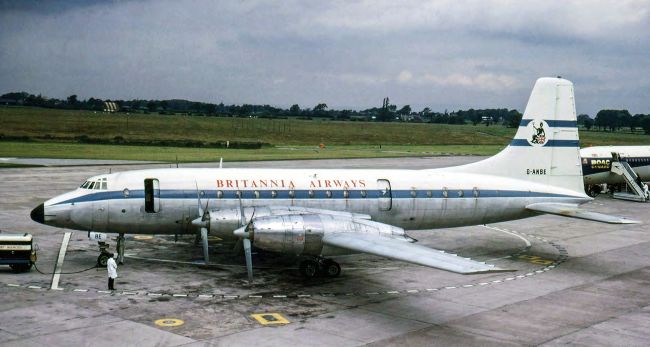
Euravia became Britannia Airways in August 1964, following the introduction of the Bristol Britannia
AIRTEAMIMAGES.COM/ THE SAMBA COLLECTION
The new arrivals were converted into a 112-seat, single-class layout, and their introduction enabled the airline to enhance its offerings, marking the first of many ‘firsts’ in the airline’s illustrious history. Through a seating plan printed on booking forms, passengers could choose their seats before the flight. On board, they would be served a hot meal, traditionally cottage pie, thanks to the superiority of the type’s galley over its predecessor.
Jed Williams also saw the arrival of the Britannia aircraft as the perfect opportunity to rebrand the airline, considering Euravia a “lousy name for an airline”. So, on August 16, 1964, Britannia Airways was born.
Around this time, a new character was introduced to the TUI story. Roy Herbert Thomson, 1st Baron Thomson of Fleet, was a Canadian-born newspaper magnate and one of the moguls of Fleet Street following the end of World War Two. Keen to diversify his business, Thomson’s attention had been grabbed by the rapid growth of the package holiday industry. After being turned down by Horizon Holidays, he turned his attention to Universal Sky Tours, its subsidiary, Riviera Holidays, and its in-house airline. The £900,000 deal was signed in 1965, signalling the start of an exciting new chapter for Britannia.