23 January 2023
Webb uncovers an icier side to space
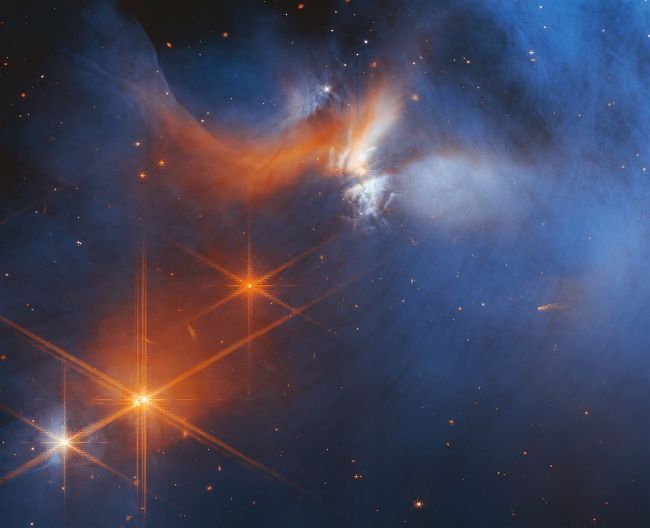
© NASA; ESA; CSA
The James Webb Space Telescope has peered deep into a dense molecular cloud and found a rich variety of pristine interstellar ice, including a range of molecules crucial for life. Spotted at frigid temperatures of -263 degrees Celsius (-440 degrees Fahrenheit), these finds are the coldest ices ever measured. “We simply couldn’t have observed these ices without Webb,” Klaus Pontoppidan, an astronomer at the Space Telescope Science Institute said. Webb studied a neighbourhood that scientists call Chameleon I in the constellation of Chameleon. 500 light years away from Earth, it’s one of the closest star-forming regions, with dozens of pockets alive with young stars. The region belongs to a family of what astronomers long thought to be holes in the sky: dark molecular clouds so dense with gas and dust that visible light from background stars fails to penetrate them. Clouds like Chameleon I are stellar nurseries; their collapse over time forms stars. The chemical composition of these systems and any building blocks of life they may contain, however, is determined by the ices embedded deep inside the molecular cloud.