MORE POWER!
HOW TO SELECT THE RIGHT GENERATOR FOR YOUR NEEDS
BY JIM JEFFRIES
Power outages can happen anytime, and the duration may be minutes, days or much longer. As it is their business to supply power to consumers, utility companies are quick to respond in most cases – but as millions of customers in California’s more rural areas have discovered, power companies will intentionally shut off the flow of electricity for days at a time in the name of public safety.
Utility companies recommend personal power generation as a critical part of a preparedness plan, and this is especially crucial for families that include someone with medical issues that depend on devices reliant on electrical energy – be it an electrically powered oxygen concentrator or a refrigerator for insulin.
SIZE MATTERS
Large standby generators are employed by hospitals, municipal buildings, public safety departments, as well as many businesses and homes to cope with power outages. These permanently installed generators are driven by internal combustion engines that run on diesel fuel, natural gas or liquefied propane (LP/LPG), and the power generator system is sized to meet the demand of the facility which it powers. On the other hand, most portable generators on the consumer market run on gasoline; but just like the big standby generators that automatically start up and kick in when grid power is lost, portable generators must be sized to meet the load they are intended to power – be it just an essential appliance plus a few lights, or an entire home including the HVAC system, electric range, water heater and dishwasher. There is no one-size-fitsall solution, and the price range for portable generators runs from a few hundred dollars to several thousand. Choosing the right portable generator for your needs requires a good deal of consideration, some calculation, and a bit of speculation.
”PUTTING BUDGET ASIDE, THE FIRST CONSIDERATION IS WHAT YOU INTEND TO POWER. THE MORE DEVICES, OR THE HIGHER THE CURRENT REQUIREMENT FOR THE MOST POWERHUNGRY APPLIANCE YOU NEED TO RUN, THE HIGHER THE OUTPUT CAPACITY OF THE GENERATOR MUST BE.”
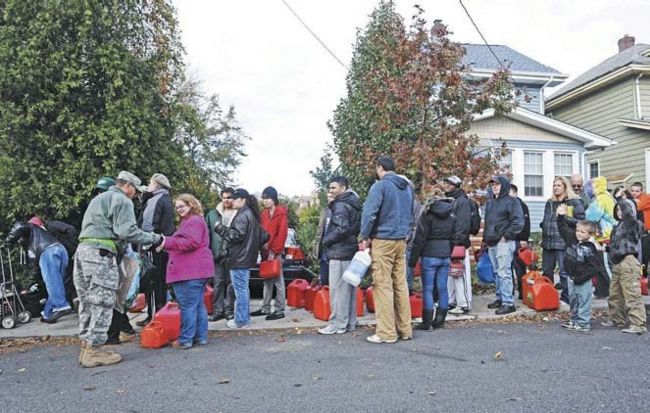
During a widespread power outage caused by hurricane Sandy in 2012, residents lined up at New York National Guard Armories to wait for fuel, provided by FEMA, to run their generators. U.S. Army Photo by Sgt. 1st Class Jon Soucy (DVIDS)