HIT TOP SPEED
HOW EFFECTIVE ARE OVERSPEED TRAINING TECHNIQUES AND HOW CAN YOU BEST USE THEM? ASKS JOHN SHEPHERD
HOW CAN you improve your top speed? That’s a question that coaches worldwide have been pondering for years and years. Overspeed training has been seen as a possible answer – it involves using, for example, bungee-type devices, downhill runs, super-fast treadmills and even car towing to allow athletes to run supra-maximally. But is overspeed training overrated?
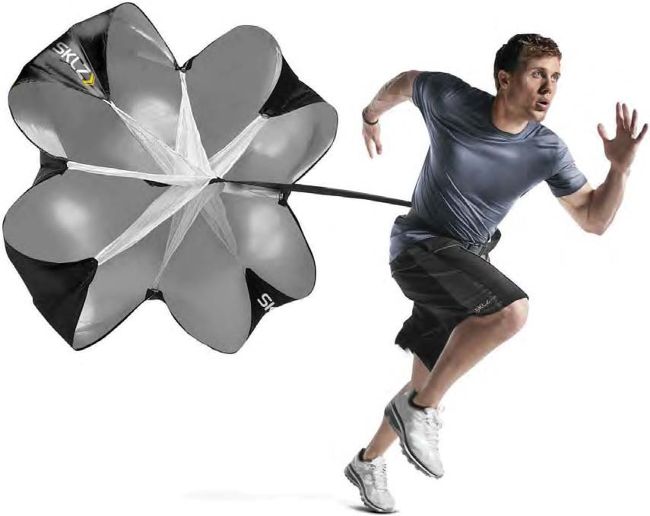
Kite running: recent studies have proven the training method to be effective for decreasing ground contact time in sprinters
Downhill sprints
This is perhaps the simplest way to achieve an overspeed condition. You’ll need a flat surface – dry grass is an option but you may be lucky enough, if training abroad in particular, to find a specifically constructed facility. My training group used such a facility in Monte Gordo in Portugal recently for warm-weather training – however, it had its problems for overspeed use due to its relatively steep angle options. The decline really needs to be very minimal – 3% or less being recommended in most studies. If the angle is greater then the athlete may not be safe to sprint effectively beyond flat-out and there may be very limited potential for transference into actually improving sprint performance, mainly because sprint technique will be adversely affected.