D-Day memories
This year marks the 75th anniversary of D-Day. Today it’s on the cusp of history within living memory, part of our shared cultural legacy, but also part of the very personal memories of the people who lived and fought through those times. John Leete gathers together anecdotes from those who experienced the build up to and launch of D-Day from Britain’s Home Front
OUR ANCESTORS REMEMBER
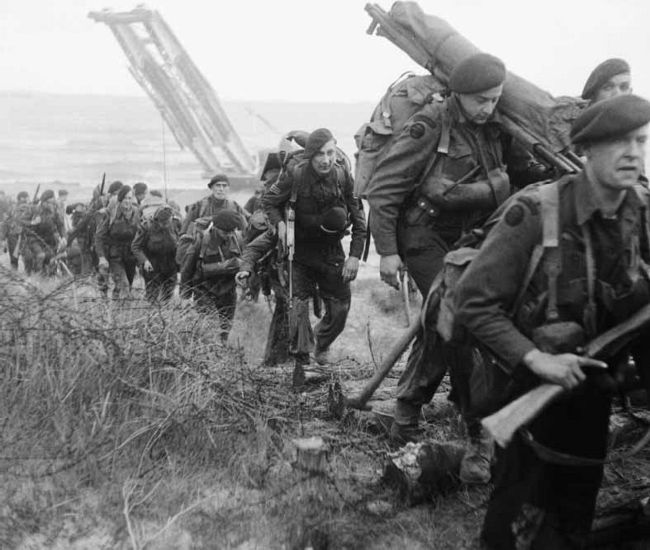
Royal Marine Commandos landing on Sword Beach
This brief selection of anecdotes and accounts has been drawn from a mix of people who experienced life on Britain’s Home Front during the months up to D-Day 1944.
I am very honoured to have been in the company of the wonderful people who told me their stories. Stories told with humility, passion, emotion and laughter.
Those last few hours of waiting…
In the Signallers’ Office situated in the basement of Exbury House, on the south coast of England, Jean Gadston, a ‘Wren’ – WRNS (Women’s Royal Naval Service) – was responsible for typing up the D-Day instructions for the Fleet: ‘The establishment by then was sealed and although there was a false start on June 5th, on the morning of the 6th, I passed the order to the flotilla in the Solent and in Southampton Water and to the Landing Craft in the Beaulieu River to “sail”.’
All hell let loose when the orders came through from Headquarters, that General Eisenhower had given the Go to the invasion. My then fiancé went out on D-Day. News came through later that he had been killed
Marion Loveland, also a WRNS, was stationed at HMS Collingwood: ‘It was quiet on 5th June and I was hoping the next 24 hours would be the same. It was my birthday on 6th June, and I wanted to have a little celebration if I could. It was not to be. All hell let loose when the orders came through from Headquarters, that General Eisenhower had given the Go to the invasion. My then fiancé went out on D-Day. News came through later that he had been killed.’
A subject of discussion ever since…
Jimmy Kyle, a Typhoon pilot flying out of RAF Needs Oar Point airfield a few weeks before D-Day, related an event that has remained a subject of discussion and investigation ever since: ‘We had been airborne for about 15 minutes or so and we were circling some 20 miles out to sea. Suddenly in the distance to the east of the island a formation of German aircraft was sighted as they made an approach for the English coast. Naturally we turned to give chase. It was April 18th, 1944. The German formation wheeled away and eluded us by turning eastward towards France.