History Makers: Bad King John Robin Hood’s nemesis
It is 800 years since the birth of Magna Carta, one of history’s most important documents, yet the King who granted his royal seal to the great charter remains maligned and despised, as Jonny Wilkes explores
BAD KING JOHN
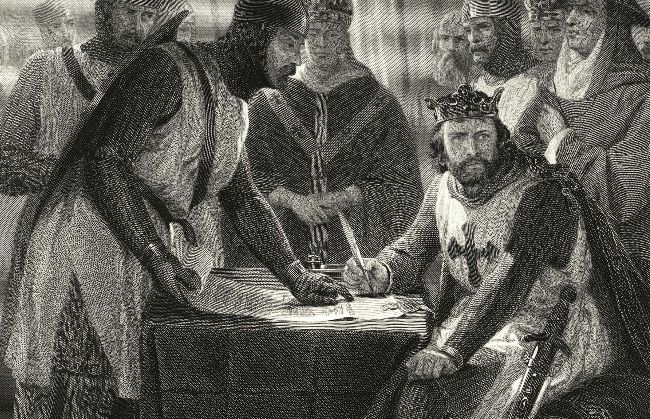
THE MAGNA CARTA KING KING JOHN DIDN’T ACTUALLY SIGN MAGNA CARTA, AS ILLUSTRATED HERE, BUT GRANTED HIS ROYAL SEAL TO IT
There is a meadow on the outskirts of London, sat on the bank of the River ames in Surrey. It doesn’t look like much, certainly not a spot heavy with symbolic meaning, but that field, Runnymede, is where one of the founding documents of human liberty was created and agreed on, 800 years ago.
The document we now refer to as Magna Carta (‘the Great Charter’) was granted the royal seal of King John on 15 June 1215. It went some way to protecting people’s rights and, crucially, it limited the powers of the Crown by putting the reigning monarch under the law. Make no mistake about it, a charter that revolutionary could only have been drawn up if there was a king who inspired great enmity among his people, and John was that King. He ruled as a tyrant, lost English territories in multiple embarrassing campaigns and squeezed every penny from his barons. And only months after Magna Carta was sealed, he turned his back on the agreement, even though he knew this would mean civil war.
John has one of the worst legacies of any English royal – not due to his fabled exploits against Robin Hood, but his pomposity, cruelty and fatal lapses in judgement. Yet, does ‘Bad King John’ deserve the dubious honour of being called England’s worst monarch?
FAMILY FEUD
Born in 1166, childhood was far from harmonious for John, the youngest son of King Henry II and his smart, powerful wife Eleanor of Aquitaine. With four older brothers, it was unlikely he would ever become King or inherit substantial land from his father’s empire, which is how he picked up the nickname ‘Lackland’. All that changed, however, when he was six. His brothers Henry, Geoffrey and Richard plotted with Louis VII of France to seize the throne from their own father. Henry II made swift work of crushing the rebellion and, even though his brothers were dealt with leniently, John leapfrogged his siblings to become the King’s favourite son.
John was presented with lands and titles, as well as a betrothal to the wealthy Isabella of Gloucester, so that before he was a teenager, he had been given the estates of the Earl of Cornwall and the lordship of Ireland. He visited the latter in 1185 – but the trip caused a political brouhaha when the inexperienced, tactless John insulted the Irish chieftains by pulling on their long beards.