The First World War and policing in the Scottish Borders
In the concluding half of his study, Dr David Smale continues to assess how the activities of the Border police forces were transformed during the First World War, while also analysing the extent of wartime criminality and the relationship between the police and the army
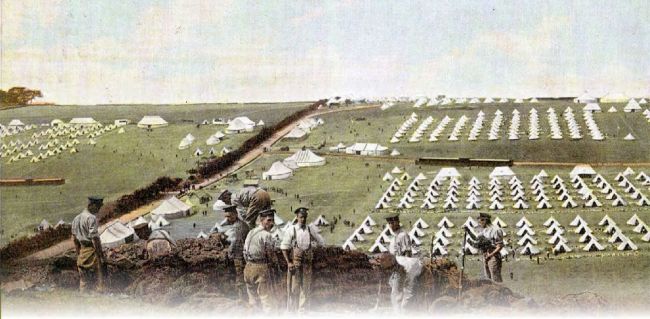
Engineers making fortifications at Stobs Camp in 1914, showing the extent of the camp
‘The people looked upon the police and every individual constable as a friend’
Besides the Defence of the Realm Act (DORA), another piece of legislation which increased the workload of the police was the Aliens Restriction Act of 1914. It required that enemy aliens of military age should be interned or repatriated. The extra administrative work led the chief constable of Peeblesshire, Sholto W. Douglas, to ask his police committee for a sergeant Hodge to be promoted:
Since the commencement of the War in August last many important and
varied duties have been imposed on the Head Quarters Staff, such as the administration of the Defence of the Realm Act, Aliens Restriction Act, etc. More recently a large number of Military have been stationed in the Burgh of Peebles. In these circumstances I beg respectfully to recommend that this officer be promoted to the rank of Inspector.
In the same county, early in August 1914, 20 German waiters who had worked at the Peebles Hydro left the Borders; they had been called back to Germany for military service. A week later the Hawick Express reported that another German recalled to the army from a comfortable position in Scotland had shouted to his colleagues as he left, ‘Now see that some of you fellows shoot that damned Emperor of ours before you are done’. Evidently some of the aliens did not wish to return to the Fatherland and to fight their neighbours in Scotland. In October 1914, the round-up of enemy aliens aged between seventeen and 45 was put into effect. In Hawick, Chief Constable Thom arrested two men in the town. One was ‘George Fuhrmann, 38 years of age, a tweed merchant… who is an Austrian, and the other was Karl Dietterle, 33 years of age, a native of Stuttgart’. They were kept in the police cells at Hawick and then taken by burgh officers to Redford Barracks in Edinburgh. In the same week at Galashiels a German alien, a watchmaker, was also removed to Redford. Several Germans were allowed to remain in Galashiels because they were considered to be old men and not of military age.
Policing in the First World War
In May 1915, following the sinking of the passenger liner Luisitania by a German U-boat, riots broke out in many English cities and there was a small disturbance in Dumfries. A large number of aliens realised that they were in danger of people seeking retribution, and so they handed themselves in to the police for their own protection. A large number of Germans and Austrians were brought to Stobs Camp from Manchester. The local police assisted in transporting them to the camp. A large crowd travelled from Hawick to see the enemy internees and had to be dispersed by the police. By 1916, there were more than 2,000 civilian internees at Stobs Camp.
In his 1915 report, the Inspector of Constabulary, lieutenant colonel A.G. Ferguson, reported that:
There has been a certain decrease in the ordinary duties of the police, but a very considerable increase of work in other directions, directly caused by the War. Hardly a week passes without the issue of a fresh circular creating some new duty or adding additional work to one already created.
During the war years, an avalanche of new Acts, regulations and instructions bore down on the beat constable. Almost every month new legislation had to be read, digested and acted upon, much of it contentious and intruding into the population’s private life, bringing the constable into conflict with the people. A small example of this wartime legislation included updates of DORA restrictions, the need to search for army absentees and those evading military service, restrictions on owning homing pigeons, control of certain types of food and limitations on sketching and photography.
This increase in police duties was not apparent to one writer in an article in the Southern Reporter in April 1916, who believed that the police should be employed filling the gaps left by men at the front. He proposed the police should deliver the post, make repairs to the roads, shovel snow in winter and act as school board officers and relieving officers to the inspector of the poor. His thinking was based on the absence of tramps and young men during the war with the result that the duties of a police officer could be adequately carried out by the special constables. He wrote: When men are so urgently needed in the fighting lines and in essential industries, it is nothing short of a crying scandal to keep the very pick of our manhood thus loafing about in idleness in sparsely populated pastoral settings.