Clearances from Arran
by John MacKenzie
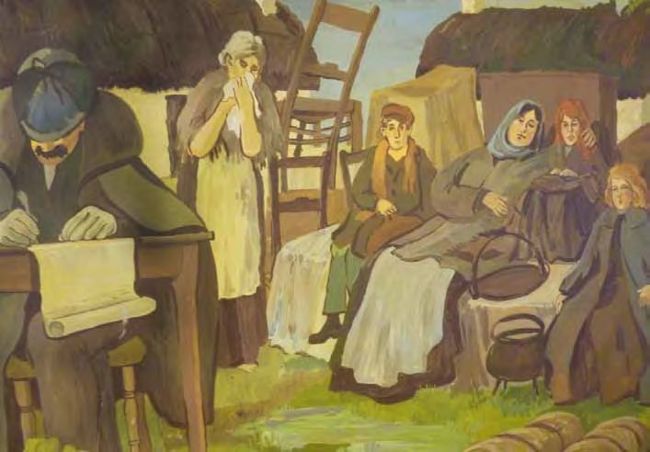
Painting of an Arran family being ‘Cleared’, courtesy of the Sannox Centre, Arran
The Clearances, as most iScot readers will no doubt already be aware, took place during the 18th and 19th centuries and involved the displacement of tens of thousands of people from their homes in the Scottish Highlands. This removal from the land, which many families had worked for generations, led to large-scale emigration to the Scottish Lowlands and North America.
Although commonly known as the Highland Clearances, the phenomenon was not just restricted to what we now think of as the Highlands. This article will take a look at how the Clearances affected the island of Arran, just 40 miles from Glasgow.
Arran in the 18th Century
The island of Arran in the 18th century was very different to how it looks today. The previous century’s Civil War had left its mark and the various communities on the island lived a fairly basic existence. A large part of the island was covered in peat which made it unsuitable for farming. However, there were low-lying areas of good soil, particularly in the south of the island, that were suitable for arable farming, while cattle, sheep and horses could be grazed in the hillier areas in the north. Farming, therefore, was the most common way for Arran folk to make a living, with fishing less prominent at this time.
Involved the displacement of tens of thousands of people from their homes in the Scottish Highlands
None of the modern villages we see today were in existence but, rather, the people lived in small settlements scattered across the landscape.
Reasons for the Clearances
One of the main justifications for the Clearances was to improve farming methods by replacing the old ‘runrig’ system of farming with a new system of enclosed farms.
Runrig farming involved small family groups running their narrow strips of cultivation side-by-side. The strips were reallocated annually so there was little incentive to improve the land. Robert McLellan explains:
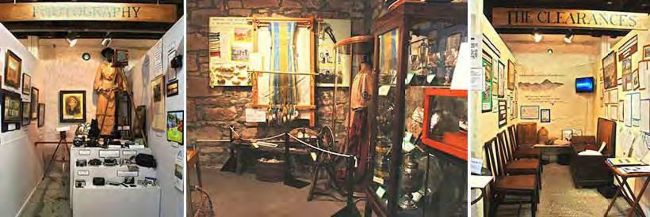
Arran - Heritage Museum Exhibition
The families would share their accommodation with their animals
“The ground to be cultivated in any one year was in several plots, of varying sizes, determined largely by the lie of the ground, each separated from the other by the fallow of previous years, or by a rocky outcrop, a steep slope, a stretch of bog, or a burn. In each of these plots there would be so many rigs, and it seems to have been in terms of rigs and their constituent furrows that each plot was divided among the sub-tenants.”
The basic crops grown were oats, barley and potatoes.
The introduction of larger enclosed farms would mean drastically reducing the number of tenants in each ‘fermtoun’ or ‘clachan’. The old runrig system of agriculture was based on small clachans which would provide subsistence for a number of families. These would generally be clusters of ‘black houses’, in which the families would share their accommodation with their animals.