Foul Weather Friend
MiG-320 Interceptor
By Ken Duffey
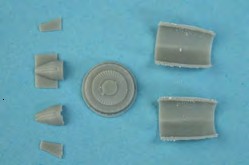
Parts for the VK-1 jet pipe
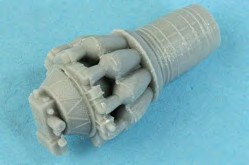
Completed VK-1 engine, with the flanges removed in error
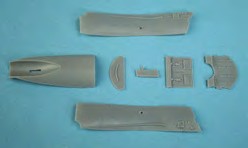
The intake trunking and cockpit parts prior to painting
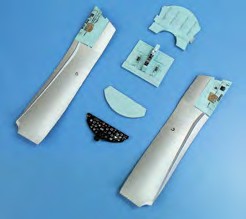
Here’s how the interior parts look painted up and with the addition of the instrument panel decal
Kit No: 72038
Scale: 1/72
Type: Injection Moulded
Plastic
Manufacturer: Modelsvit Hannants/Stevens Internationa
Making its first flight on 26th April 1949, the I-320 was designed to fulfil a Soviet Air Force requirement for a twin engined night/all weather fighter with a powerful intercept radar and cannon armament. Mikoyan adopted an unusual layout for the I- 320, with the two Klimov VK-1 turbojets (copies of the Rolls-Royce Nene) mounted in tandem, both fed from a nose intake but with the forward engine exhausting under the lower centre fuselage and the rear mounted engine exhausting more conventionally via a long tailpipe to the rear. The two crew members sat side by side on ejection seats under a large glasshouse canopy and the air intercept radar, initially Toryii and later, on the third prototype, the much improved Korshun set, was mounted in a small radome above the nose intake. Armament was provided in the form of two Nudelman N-37 37mm cannons on either side of the nose. Following flight tests with the initial RD-45 powered R1, the second R2 was fitted with the more powerful VK-1 turbojets, a third N-37 cannon on the starboard side and a revised cockpit canopy. After being damaged during flight tests, it was rebuilt as the R3 prototype incorporating a third upper wing fence and a reduction in the wing anhedral from -3.0 degrees to -1.5 degrees. The type never entered production and nor did its two main rivals, the similarly configured Lavochkin La-200 and the single seat Sukhoi Su-15, both of which employed the same engines in the same tandem layout.
Designed to the same basic requirement, the contemporary Gloster Meteor NF-12 had a very different layout with tandem crew and engines mounted on the wings making its first flight in 1950.