ROAD TEST No 5595
Genesis Electrified G80
Korean luxury brand ’s second EV is a converted ICE car. Does that help or hinder it?
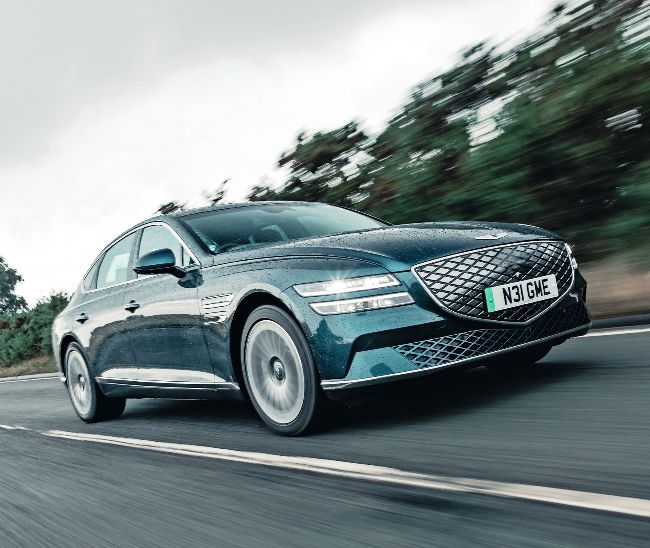
PHOTOGRAPHY MAX EDLESTON
MODEL TESTED ELECTRIFIED G80
Price £65,000● Power 365bhp● Torque 516lb ft ●0-60mph 4.4sec ●30-70mph in fourth na● Fuel economy
3.2mpkWh
●
CO
2
emissions 0g/km●
70-0mph 45.4m
The introductions of new Genesis cars continue apace. In just over a year, Hyundai’s premium spin-off has launched no fewer than five new models in Europe, making it clear that this is no toe in the water but a concerted effort to, in time, seize a significant portion of the market. We have so far road tested the GV80 large SUV, the G70 compact executive saloon and the GV60 electric crossover, and while all have been likeable for their design and sumptuous interiors, it’s only the GV60 that has really impressed across the board, earning four stars.
The combination of the EV technology that proved class-leading in the Hyundai Ioniq 5 and Kia EV6 with Genesis’s premium veneer proved quite compelling, and avoided one of the main issues that has been plaguing the brand’s cars: petrol and diesel engines that aren’t up to the standard of the European opposition.
This week’s road test subject is something else again. It’s the G80 saloon – Genesis’s Mercedes E-Class rival – but with an electric drivetrain in place of its petrol and diesel engines. Does the Electrified G80 surf on the GV60’s wave or fall into the traps of other Genesis models?
DESIGN AND ENGINEERING
Given the existence of the E-GMP platform that underpins the Kia EV6, Hyundai Ioniq 5 and Genesis GV60, it would be easy to assume it forms the basis of the Electrified G80 as well.
Instead, it uses the same Genesis-specific architecture as the petrol and diesel G80, and the GV80. This platform was designed with electrification in mind, but is nevertheless quite compromised when loaded with 87kWh and 546kg worth of battery cells. The pack clearly intrudes into the interior and leaves no luggage space under that long bonnet.
Genesis has done a creditable job at keeping the weight down, as absurd as that might sound when talking about a car that tipped our scales at 2349kg. It is no heavier than a dual-motor Porsche Taycan and weighs only slightly more than the smaller BMW i4 M50. The Tesla Model S P90D we weighed back in 2016 was 100kg lighter, though.
Compared with the regular G80, the Electrified uses more aluminium in the suspension towers, sills and rear bulkhead, as well as CFRP in the front seat crossmember. These changes render the body-in-white 46kg lighter and 17% stiffer than the petrol and diesel G80.
Although the Electrified G80 doesn’t use the E-GMP platform, it does benefit from an 800V architecture, enabling ultra-fast charging. The peak charge rate of 240kW is slightly lower than that of the E-GMP cars but is still one of the fastest you will find in any car today. Find a suitable charger and a 10-80% top-up should take just 22 minutes. On a 50kW charger, the same takes 67 minutes, while a 10-100% charge on an 11kW home wallbox will take seven and a half hours.
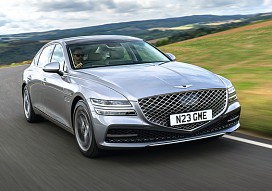
G80 first landed in petrol and diesel forms
Visually, the Electrified G80 doesn’t stray too far from the regular G80. It’s a very different approach from that of Mercedes, whose EQE is an entirely distinct car from the E-Class. The Electrified G80 retains the Genesis ‘Crest’ grille, though it is now a solid panel with a diamond pattern that hides the radar sensors and the door for the charging port.