The 1948 Locomotive Exchanges The express classes
A process of evaluation through ten weeks of operation across four regions and involving five classes and ten individual locomotives,Andrew Wilsonexamines the tests and outcome of the passenger designs used in the 1948 exchanges.
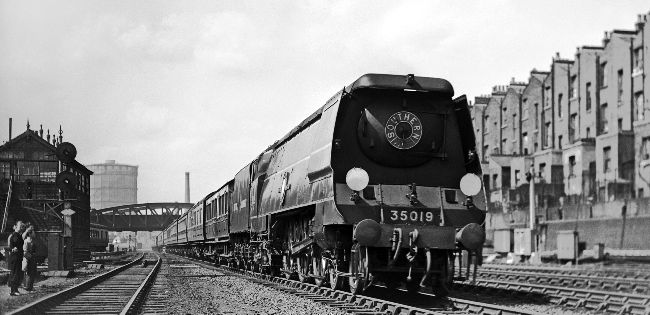
With the Southern Region engine looking immaculate in malachite green but contrasting with the black of the temporary tender needed for the locomotive exchanges, Bulleid ‘Merchant Navy’ Pacific No 35019 French Line C.G.T. passes Westbourne Park while on approach to Paddington station with the 1.44pm arrival from Plymouth on 28 April 1948, the leading carriage being the Western Region’s dynamometer car. On this particular run No 35019 left Westbury over six minutes late and managed to recover four minutes by Reading. Beyond, despite checks at Twyford, the 525 ton train was worked up to 71½mph through Slough, allowing a 1½ minute early arrival at Paddington - C J Allen calculated that French Line C.G.T. knocked some 12 minutes off the booked times on this day, the run vividly illustrating the ability of the ‘Merchant Navy’ class when hauling heavy express trains.
F R Hebron/Rail Archive Stephenson
Almost 73 years ago Britain was an austere, grey and war-ravaged country teetering on the brink of bankruptcy, with the Labour government of Clem Attlee undertaking a radical policy of nationalization. On 1 January 1948 the Railway Executive of the British Transport Commission came into being (British Railways as such did not appear until 1949), and within weeks it was announced that there was to be a comparative interchange of express, mixed traffic and freight locomotives between the new regions that had replaced the private companies. At this news, railwaymen, enthusiasts and newspapers became very interested in the events about to unfold.
Of course such trials were not new. The Rainhill Trials of 1829 were notable for proving the efficacy of the Stephenson smoke-tube boiler. The North Eastern Railway tested Simple and Compound versions of the same basic design, and also one of its Compound Atlantics against a Midland Compound. Lancashire & Yorkshire Railway and Great Northern Railway 4-4-0s were pitted against each other. However, it was the trials arranged between 1908 and 1910 that proved more long-lasting on future developments - 1909 saw the London & North Western Railway comparing its ‘Precursor’ 4-4-0 class against a GNR ‘Large’ Ivatt Atlantic, and later a London, Brighton & South Coast Railway Marsh ‘I3’ superheated 4-4-2T, with the latter ‘I3’ conclusively proving the advantages of superheating. An ‘Experiment’ 4-6-0 was also trialled against the Caledonian Railway’s 4-6-0 Cardean and a North British Railway Reid Atlantic, and then 1910 saw the vindication of Churchward’s ‘Star’ class when still saturated as Polar Star proved its prowess between London (Euston) and Crewe.
More momentous were the events of 1925 and 1926 when ‘Castle’ class 4-6-0s proved Swindon’s technological advances over the LNER and LMS - Nos 4074 Caldicot Castle and 4079 Pendennis Castle were tested against Gresley’s ‘A1’ Pacifics and showed the advantages of long-travel valve gear, the outcome being the almost universal adoption of this feature, and GWR No 5000 Launceston Castle was loaned to the LMS in the autumn of 1926 and paved the way for the abandonment of Fowler’s Compound Pacific in favour of the ‘Royal Scot’ class 4-6-0s.
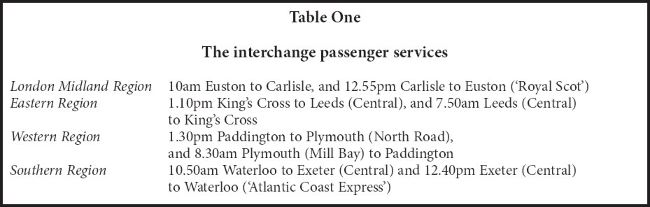
The 1948 trials were to be in a different league to those that had preceded them. Express, mixed traffic and freight types were to be compared and the testing would take place over a period of five months, from mid-April to the end of August, as only three dynamometer cars were available. This meant that the Euston to Carlisle, King’s Cross to Leeds, and Paddington to Plymouth trials could run between 19 April and 28 May, with the Waterloo to Exeter tests run between 31 May and 25 June. Those locomotives running on ‘foreign’ lines would work a down train on Tuesdays and Thursdays and up trains on Wednesdays and Fridays to give their crews a chance to get to know the routes, with the test running proper the following week. The test trains were to be normal timetabled services (see Table One) but with the addition of a dynamometer car.
It was arranged that all the locomotives would have run between 15,000 and 25,000 miles since their last general repair and be taken straight out of traffic for the tests. They were to use the same coal, South Kirkby ‘Barnsley Hards’, which would disadvantage the Western Region locomotives as they were designed to burn Welsh steam coal. The trains would be made up to agreed weights and be manned by their normal crews. Little or no instructions were given to the crews or pilotmen on how they should fire or drive their locomotives, particularly when it came to regulator openings and cut-offs used. At weekends all the locomotives were returned to their home sheds.
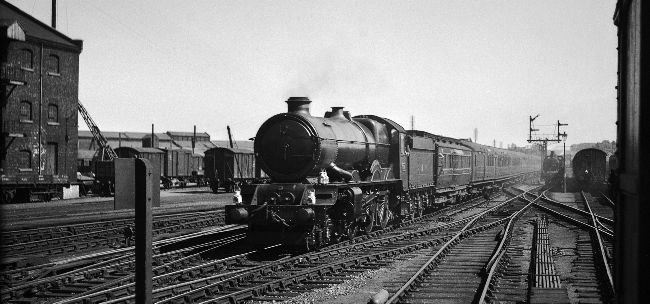
On its first Eastern Region test run on Tuesday, 18 May, its Western Region crew having had four preliminary journeys to get used to unfamiliar coal and the need for a pilotman, Collett ‘King’ class 4-6-0 No 6018 King Henry VI runs into Grantham with the 1.10pm London (King’s Cross) to Leeds (Central) passenger service. Some 105½ miles into their journey, the locomotive and crew have just climbed Stoke bank and then taken advantage of the falling 1 in 200 gradient before the Grantham stop. In the up direction, the blanket 70mph speed restriction in force on the Eastern Region would prevent No 6018 from showing its ability to run fast down Stoke bank. The oldest of the express types on test, it would not be until the early 1950s when Sam Ell had proved that a high superheat boiler and double chimney were necessary in post-war conditions that the ‘Kings’ would be able to match the thermal efficiency of the more modern express types involved in the 1948 exchanges.
V R Webster/Kidderminster Railway Museum
The express classes to be tested were Gresley ‘A4’ Pacific, Stanier ‘Coronation’ Pacific, rebuilt ‘Royal Scot’ 4-6-0, Bulleid ‘Merchant Navy’ Pacific and Collett ‘King’ 4-6-0. Table Two offers comparative details of the five types. The ‘King’ could not be used on the London Midland or Southern regions so the tests could not be completely comprehensive, and some observers also questioned the omission of a ‘Castle’ when the rebuilt ‘Royal Scot’ was included, but the latter was a 1943 design whereas the ‘Castle’ dated from 1923. The Thompson ‘A1/1’ Pacific was also not included as there was only one example in traffic, No 60113 Great Northern, and the Peppercorn ‘A1’ Pacifics did not enter traffic until the tests were underway.
One ‘King’, Newton Abbot shed’s No 6018 King Henry VI, was tested over the Western and Eastern regions, while one ‘Coronation’, No 46236 City of Bradford, was transferred from Crewe North to Camden for the duration of the exchanges and worked all the preliminary and test trains for its type on all four regions. Three ‘A4s’ from King’s Cross shed - Nos E22 Mallard, 60033 Seagull and 60034 Lord Faringdon - covered the ‘A4’ tests, and two rebuilt ‘Royal Scots’, Nos 46154 The Hussar and 46162 Queen’s Westminster Rifleman from Camden, shared their tests, while the ‘Merchant Navy’ choice fell on Nine Elms-allocated Nos 35017 Belgian Marine, 35018 British India Line and 35019 French Line C.G.T., with No 35020 Bibby Line held in reserve in case of failures. While working over the Southern Region both Nos 46236 and 46154 were coupled to ‘WD’ eight-wheel tenders to increase their water capacity as the region had no water troughs. The two ‘Merchant Navy’ Pacifics that saw use on the Eastern, London Midland and Western regions were coupled to Stanier tenders to enable them to collect water from the water troughs.
Ten different passenger locomotives were used during the exchanges. The oldest was GWR ‘King’ class No 6018 King Henry VI, which first emerged from Swindon Works in July 1928 and was allocated to its first shed, Wolverhampton Stafford Road, on 1 August. By the time of the tests it had been in traffic for 20 years, having run in the region of 900,000 miles. A general overhaul completed at Swindon Works on 5 March 1948 saw No 6018 King Henry VI have sufficient time to accumulate the necessary mileage to be a suitable candidate for the trials.
The next oldest contestants were the three ‘A4’ Pacifics, which were all put into traffic in 1938, making them 10-years-old in 1948 - Mallard was completed on 3 March, Seagull on 28 June, and Lord Faringdon was new as Peregrine on 1 July. All three were built new with double Kylchap exhausts. Mallard went through Doncaster Works for a general repair between 16 January and 5 March 1948, Seagull between 25 October and 12 December 1947, and Lord Faringdon between 15 October and 12 December 1947. All three received attention again prior to the tests, with Lord Faringdon called in between 21 March and 24 March 1948, Mallard between 5 April and 8 April, and Seagull from 23 March to 16 April. These engines were estimated to have each completed around 500,000 miles in traffic since being built