DIESEL PRESERVATION
THE FIFTY FUND / CLASS 50 ALLIANCE AT 30 A PRESERVATION ODYSSEY
Active preservation of Class 50 locomotives reaches a significant milestone in 2021, which sees the 30th year of their ownership in private hands. The Fifty Fund purchased the first machine to enter preservation – No. 50035 Ark Royal – in April 1991 and one of the founding members of the group, Jonathan Dunster, outlines what, by any measure, is a remarkable story.
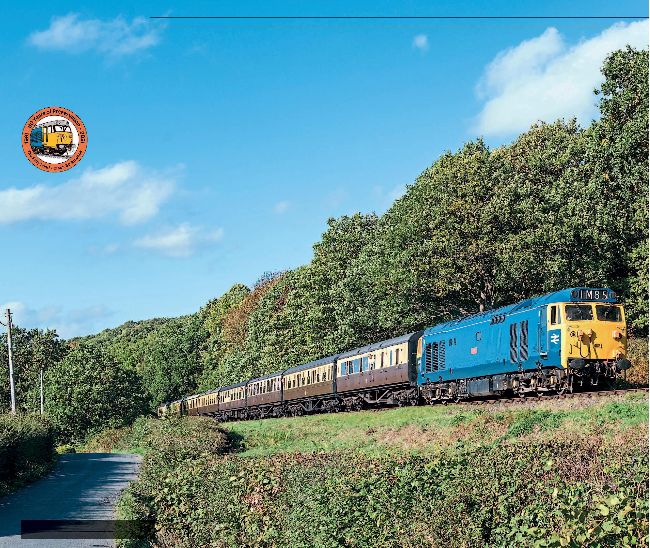
Class 50 No. 50044 Exeter runs alongside Northwood Lane, Bewdley, with a working from Bridgnorth during the Class 50 Golden Jubilee Gala on October 4, 2018. INSPIRING IMAGES
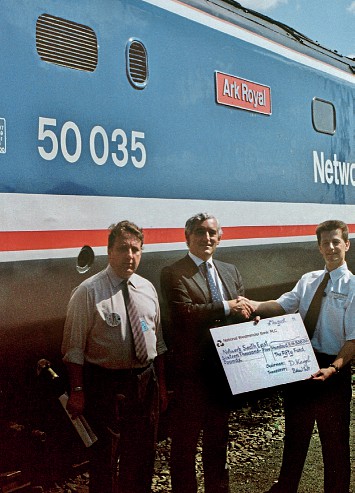
An historic moment as Dave Keogh hands over a cheque for £16,535 to Chris Green, then managing director NSE, for the purchase of No. 50035 at the Old Oak Common Open Day in August 1991. CRAIG TAYLOR
THE Fifty Fund was formed by myself and Dave Keogh in October 1988 as it became clear that the Class 50s were being rapidly phased out by British Rail.
Originally publicised by word-of-mouth between Class 50 enthusiasts, the club quickly gained support and was publicly launched in February 1989. Funds were achieved by means of a simple share ownership scheme, with shares priced at £25.
By the summer of 1990, as withdrawals of the class accelerated, more than £20,000 had been raised, and we wrote to the BR Director of Supply requesting to be included on notification of any tender for the sale of Class 50s. After several such approaches and with no further information being provided as to when any ‘50s’ would be disposed of, towards the end of 1990 I eventually wrote to the managing director of Network SouthEast, Chris Green, to advise him of our intent and to request that he might consider disposal of some locomotives for preservation.
Not long afterwards in early 1991, a tender list was issued offering locomotive Nos. 50008 Thunderer, 50019 Ramillies and 50035 Ark Royal for sale. The inclusion of 50008 was curious as it was still in service, and it was subsequently withdrawn from sale, leaving just 50019 and 50035 up for grabs.
Following examination of both, we submitted a bid for 50035 based on it being in better overall condition and, in April 1991, we were advised our bid had been successful. So, now what did we do? Fundraising had been relatively easy, but now we had 117 tons of heavy engineering to restore!
Our locomotive was lying at Old Oak Common Depot and, with an open weekend planned there in August 1991, we had the perfect opportunity for a handover ceremony. Many hours were spent preparing 50035 and we were honoured when Chris Green agreed to officiate.
Rather than be based on a heritage railway, we initially agreed to base ourselves at St Leonard’s Railway Engineering so the locomotive could be kept under cover. It moved there in September 1991 via one more public appearance at Brighton Lovers Walk.
One becomes three
British Rail released two more batches of ‘50s’ for sale in the autumn of 1991; the first containing many locomotives that had been stripped to keep the active fleet in traffic, and the second containing five locomotives at Laira Depot that had been purposely kept intact. We examined all of those on the first list and to some surprise found 50044 Exeter at Stratford TMD to be relatively intact, so we decided to submit a bid just above scrap value – essentially to purchase it as a source of spare parts.
At the same time, two of our shareholders came forward with the intention to purchase one of the complete locomotives at Laira and place it in our care. After examination and following advice from Area Fleet Manager Plymouth, Geoff Hudson, a bid was submitted for 50031 Hood. Both bids were successful and, as a result, in just over three years of existence we had become owners of three locomotives.
During this period we also invested heavily in spare parts being sold off by BR and visited several scrap dealers to obtain further items, including a spare engine and main generator from 50018.
Operations begin
50031 was fully operational and after some minor attention at St Leonard’s in early 1992, it was offered to any railways interested in having it for their diesel events. The Severn Valley Railway was keen for us to operate at its May Diesel Gala and in those days, as is the case today, the events were considered one of the highlights of the diesel preservation calendar.