ROAD TEST No 5534
Nissan Qashqai
Nissan refreshes its best-seller. Does this new-generation version regain the class lead?
PHOTOGRAPHY LUC LACEY
MODEL TESTED 1.3 DIG-T 158 TEKNA
Price £31,565 ● Power 156bhp ● Torque 192lb ft ● 0-60mph 10.0sec ● 30-70mph in fourth 12.3sec ● Fuel economy 43.0mpg ● CO 2 emissions 145g/km ● 70-0mph 47.3m
We like
• Interior feels modern but remains easy to use
• Ride and seats score on comfort
We don’t like
• Engine and manual gearbox are not well matched. The alternative is a CVT automatic
• Infotainment already feels dated
T he subject of this week’s road test has been dubbed the Nissan Cashcow by some in industry circles. That’s because the Qashqai crossover almost single-handedly saved Nissan in Europe when the first generation was launched in 2006. It really popularised the idea that you can have something that looks like an off-roader without it actually needing all the heavy, inefficient hardware to make it capable in the mud – and people responded in numbers.
Although practically every other manufacturer followed suit and produced a competitor, Nissan’s original continues to top the UK crossover-class sales. With 52,532 registrations in 2019, it was the fifthbest-selling car in the UK, beating its Ford Kuga rival by more than 10,000. It even managed to maintain its position in the extraordinary year that was 2020.
As well as being a success story for Nissan, the Qashqai is also a shining beacon for UK car manufacturing, having been produced in Sunderland from the start. As car maker after car maker closes its UK manufacturing base – Honda made its last Civic in Swindon only a few weeks ago – it is heartening that the new, third-generation Qashqai continues to be made here.
The second-generation Qashqai had been around since 2013 so it’s remarkable that although it lagged somewhat behind the best of the competition, it remained on the pace in sales terms. It makes sense, therefore, for Nissan to tread carefully with the new one. Indeed, its strategy of making its pure-electric SUV, the Ariya, a completely separate model leaves room for the EV to be a bit bolder, while the Qashqai remains a crowd pleaser.
DESIGN AND ENGINEERING
★★★★☆
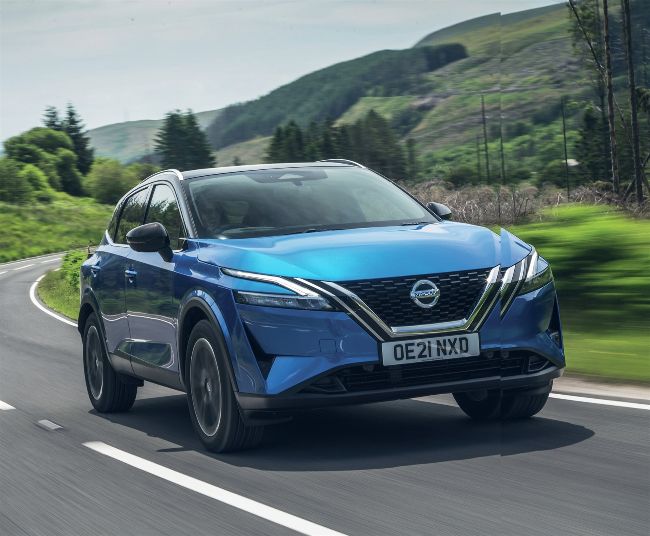
This car’s design certainly ticks a great many of the boxes expected of a compact SUV in 2021. Sharp LED light signature? Check. Contrasting ‘floating’ roof? Check. Option of massive, bi-colour wheels? Check. Slightly larger in every direction? Check. In fact, the new Qashqai is quite a bit larger than its predecessor, at 35mm longer (20mm of that in the wheelbase), 25mm taller and a rather significant 32mm wider. It clearly retains the family link with the old one, though, particularly at the rear.
Although the Qashqai’s purpose is not to shock, the new one does receive plenty of distinguishing design features, among them the vertical air ducts in the front bumper, a floating roof design, those new LED headlights and no fewer than 16 exterior colour combinations from which to choose.
Change is a little more radical under the bonnet, where all of the old model’s diesel engines have been put out to pasture, leaving a completely electrified line-up. The 1.3-litre four-cylinder turbocharged petrol unit that was introduced with the previous generation’s last facelift is carried over and is again available with either 136bhp or 156bhp, but it gains mild-hybrid assistance. Both versions come as standard with a sixspeed manual gearbox, with a CVT being optional on the higher-power version. The 156bhp engine can also be had with all-wheel drive.