WAR PEACE
IGNORANCE IS STRENGTH
by
OWEN MATTHEWS
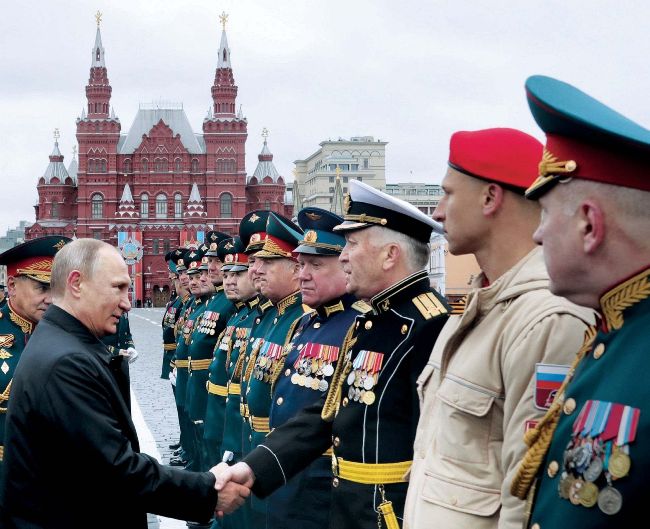
HEAVY HAND Russia’s military engagements are small, but Putin is building up the idea that his country is on the verge of a cataclysmic conflict that will require all of Russia’s resources.
MIKHAIL KLIMENTYEV/TASS/GETTY
PUTIN
RUSSIA, SURROUNDED BY ENEMIES, IS READYING TO FIGHT an epic war for survival. At least that’s what Vladimir Putin wants his countrymen to think. Nearly every evening, Russian state-controlled television leads news broadcasts with video of Russian planes in action over Syria, interspersed with images of NATO tanks and troops menacing Russia’s borders. On 60 Minut, Russia’s top-rated political talk show, analyst Nikita Isayev recently spoke of Russia’s “great victory” in Syria heralding the country’s return to “superpower status.” And in late November, Putin put Russian business on alert: “The ability of our economy to increase military production and services at a given time is one of the most important aspects of military security”, he told a meeting of top military brass in Sochi. “All strategic and simply large-scale enterprise should be ready.”
Like much Russian propaganda, the Kremlin’s claim that the country is at war is based on a kernel of truth. But it’s a very small kernel. In Syria, a single squadron of around 36 Russian combat aircraft serviced by 4,751 personnel based mostly at the Khmeimim airfield has been in action since September 2015. And in eastern Ukraine, Russian regular soldiers in unmarked uniforms have been spotted patrolling alongside rebel irregulars—most recently in the middle of November, when several hundred anonymous troops known as “little green men” showed up in the rebel city of Luhansk to prevent a bloody power struggle between separatist leaders who broke away from Kiev in the summer of 2014.
With Russia’s actual military engagements so small, why is Putin building up the idea that his country is on the verge of a cataclysmic conflict that will require full-scale mobilization of all Russia’s resources? The most obvious reason is the oldest ruse in the politicians’ book—unite a country behind an imagined external enemy to distract from domestic problems. As Russia’s economy reels under the impact of Western sanctions imposed after Putin’s 2014 annexation of Crimea, creating a myth of perpetual war has become a mainstay of the regime’s survival. “Putin doesn’t have the money to offer a lot to the population— household incomes have been contracting for four years in a row”, says Pavel Felgenhauer, a columnist at the independent Moscow daily Novaya Gazeta. “He will be running his re-election campaign [in 2018] on a national security basis, presenting Russia as a country under siege, under attack.”