ALL IN THE FAMILY
1932 CUMMINS MODEL H TO THE 2002 N14
Part 2
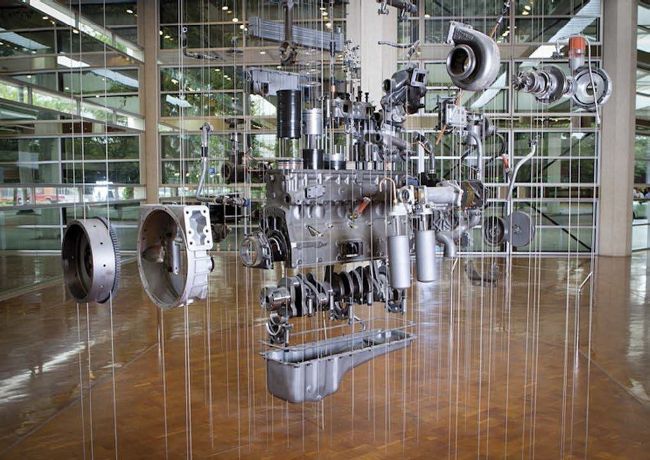
This exploded sculpture of a Big Cam III was erected in the Cummins headquarters lobby in 1983, and it looks like it will still be there after renovations are completed in 2019. The work was orchestrated by Cummins Applications Engineer John Walter and is considered a masterpiece of technical art. Walter, a B-24 pilot in World War II, has passed away, but his legacy lives on at Cummins. (Photo: Cummins Historical Collection)
From its start in 1932, the Model H diesel had been a prime mover and, by 1960, it had helped the Cummins Engine Company attain a leading industry position. It was one of those “just right” engines for many applications, but in an everchanging market, the Cummins engine lines also had to be ever-changing. The inherent flexibility of the core architecture would be tested by changes even Clessie Cummins might not have been able to imagine.
Speaking of Clessie, by 1960, he was long out of the managerial and manufacturing loop at Cummins Engine Company. For one thing, he was 72 years old at that point, and the pace of a modern company trying to stay at the top of a manufacturing peak is generally not for older men. The term, “creative dif ferences,” also applies, and while those differences got heated at times—like relatives who argue politics at the Thanksgiving table—there was a deep core of friendship and respect. Clessie would transition to the “eternal machine shop” in August 1968, and he passed on during a high point for the company he helped create.
For 1960, a new variation of the original H design would debut. A simple bore change from 5.125 to 5.50 inches over the standard 6-inch stroke bumped the displacement from 743 to 855 cubic inches (most “dieselheads” will recognize that number). Ratings ran as high as 380 hp at the debut, making it a class-leading powerplant.
While the 855 helped Cummins own 60 percent of the heavy-duty truck engine market throughout much of the ’60s, it was also one of Cummins’ most challenging decades. Government regulations, a constant battle to fight off differential taxation on diesel fuel (to equalize gas and diesel prices), more competition, labor issues and growing pains would all challenge Cummins’ leadership especially hard.
SOURCES
CUMMINS Cummins.com/company/history
INDIANAPOLIS MOTOR SPEEDWAY MUSEUM IndianapolisMotorSpeedway. com/at-the-track/museum
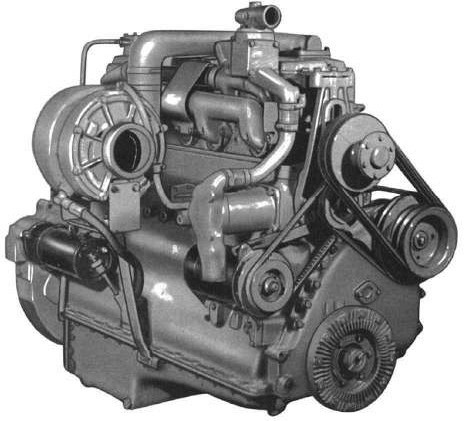
Although you could call 1960 and later the “855 era,” production of the 672 and 743 cubic inch engines did not cease. There were still markets for the previous-generation engines, and this 1960 NRTO- 6B was still a potent unit, making 335 hp at 2,100 rpm. It had reigned supreme in the ’50s and was the highest rating in the 743 cubic inch line. It remains legendary but was soon phased out of the early-’60s lineup for the lower-stressed 335 hp 855.