A Brief History of Time
Some of Doctor Who’s most dedicated fans and historians have spent years trying to untangle the series’ haphazard continuity.
FEATURE BY MATT MICHAEL
Efforts to harmonise the inconsistencies in the Doctor’s history began in the 1970s. Questions such as ‘How could Atlantis have been destroyed three times?’ (in 1966-67’s The Underwater Menace, 1971’s The Dæmons and 1972’s The Time Monster) have inspired many writers to try to reconcile the various points of view.
A notable early attempt was by former story editor Gerry Davis in the prologue to Doctor Who and the Cybermen (1974), his novelisation of the 1967 story The Moonbase. This brief, two-page summary attempted to explain the link between the cloth-faced Mondasians of The Tenth Planet (1966) and the more robotic Cybermen of the Second Doctor stories.
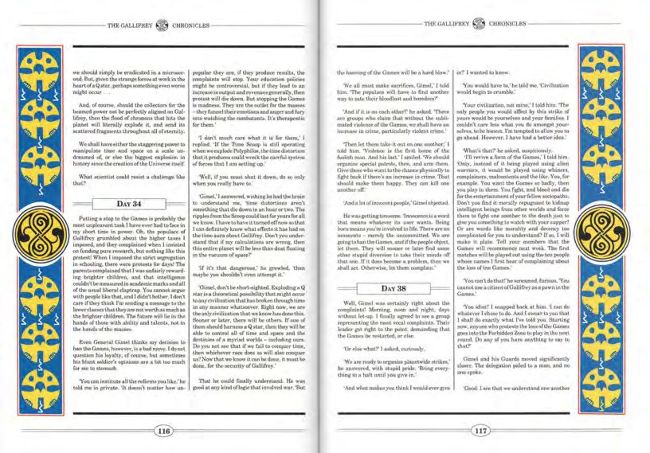
John Peel’s The Gallifrey Chronicles included extracts from ‘The Scrolls of Rassilon’. The book was published in October 1991.
However, it was in the 1990s, during the series’ long absence from television, that a whole series of books exploring the ‘in-universe history’ of the Doctor’s travels was published. Two of the most influential were published in 1991 –The Gallifrey Chronicles by John Peel and The Terrestrial Index by Jean-Marc Lofficier.
The Gallifrey Chronicles is presented as a comprehensive history of the Doctor’s planet and people, bringing together all the information revealed to that point and mixing in a lot of speculation. It’s most memorable for the final section, ‘The Scrolls of Rassilon’, which is presented as Time Lord President Rassilon’s secret diary. Rassilon reveals how he defeated the Great Vampires (in State of Decay, 1980), betrayed Omega, invented regeneration, and crossed swords with a mysterious stranger from Gallifrey’s future – who is strongly hinted to be the Doctor.
The Gallifrey Chronicles is most memorable for the final section, ‘The Scrolls of Rassilon’, which is presented as Time Lord President Rassilon’s secret diary.