TEXTING THE DOCTOR
The most serious, and arguably the most challenging, books about Doctor Who are the numerous cultural studies texts that have appeared since the early 1980s.
FEATURE BY MATTHEW KILBURN
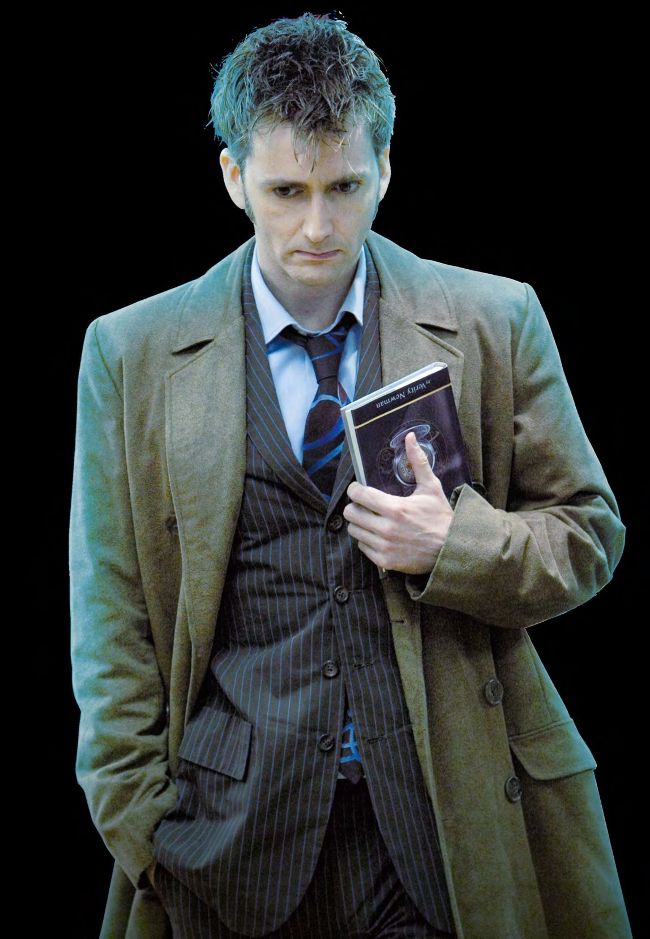
The melancholy Tenth Doctor (David Tennant) visits Verity Newman in The End of Time Part Two (2010).
Media studies emerged as a field in British further and higher education during the 1960s and 70s. It sought to apply theories developed in the study of literature to mass communication, whether newspapers, magazines and popular fiction, or film and television.
An allied but distinct field was cultural studies, which explored all forms of culture, not just that of the elite or establishment. Cultural studies borrowed the idea of the text from literary studies, but extended it to cover moving and still images, fashion, and much more from everyday life. It sought to examine the ways that different people experienced the same texts and how these could result in a variety of reactions and meanings.
The first book in this vein devoted to our favourite television series was Doctor Who: The Unfolding Text by John Tulloch and Manuel Alvarado, both of them experienced scholars of culture and media. Published in November 1983 to coincide with the programme’s 20th anniversary, it drew heavily on interviews with production personnel and cast members, past and present. And the book would soon be accorded a satirical reference in Doctor Who itself. In Part Two of Dragonfire, transmitted on 30 November 1987, a guard is given the following short speech: “Oh, you’ve no idea what a relief it is for me to have such a stimulating philosophical discussion. There are so few intellectuals about these days. Tell me, what do you think of the assertion that the semiotic thickness of a performed text varies according to the redundancy of auxiliary performance codes?”
A new generation of media analysts were influenced by Jenkins in the way they looked at the engagement between television series and their fans.
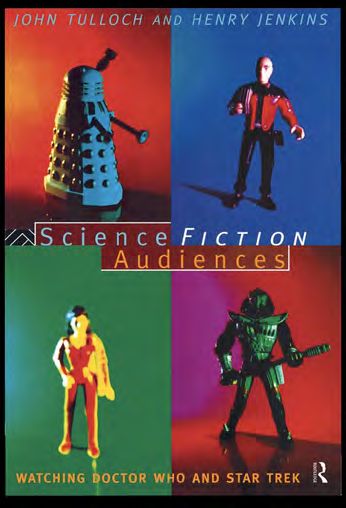
Tulloch and Jenkins’ Science Fiction Audiences: Watching Doctor Who and Star Trek was published in 1995.
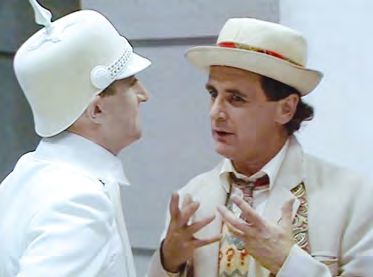
Arnheim (Chris MacDonnell) quotes from The Unfolding Text as he discusses philosophy with the Doctor (Sylvester McCoy) in Part Two of Dragonfire (1987).
That last line borrows directly from a sentence on page 249 of Tulloch and Alvarado’s book. The sentence itself is a summary of something argued by another writer in another book – Keir Elam in the 1980 publication The Semiotics of Theatre and Drama. However, for many Doctor Who fans in 1987 the line typified the mysterious language with which academics were beginning to explore Doctor Who.