GB
  
You are currently viewing the United Kingdom version of the site.
Would you like to switch to your local site?
19 MIN READ TIME

WINDSO F CHANGE

Exploring Everstone’s extravagant plan to put China at the centre of the open-world map

Game Where Winds Meet Developer Everstone Studio Publisher NetEase Format PC, consoles TBA Release 2024
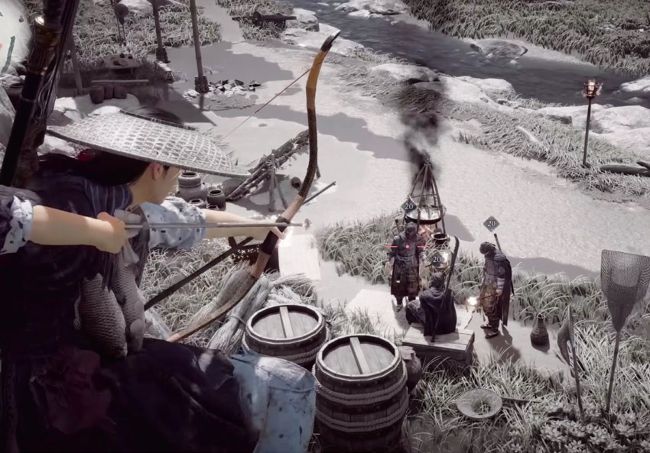
On a hilltop overlooking the lingering plains of Qinghe, the brightest and most beflowered vision of the Chinese countryside a person could imagine, there stands an academic archer. Feng Jishen wears flowing robes toxd match the waterfall of sleek black hair that spills from his topknot. He came to Qinghe, he explains to your character, a lithe and acrobatic swordsman with a generational score to settle, to study the local flora and fauna on the bidding of his tutor. But as he stood here, watching the birds fly lazy circles on the updraft, Jishen decided to try out his newly made bow and his newly made theorem that, using an obscure move from Wuxia, the mystical, physics-defying martial arts powers that define a vast and ever-popular genre of Chinese cinema, he might slow time to better strike moving targets. Jishen challenges you to a nature-off: shoot down more birds than him within the allotted time and he will gift you his notebook containing the secret knowledge to keep forever.

Arrow-time, as this pre-industrial revolution form of bullet-time might be described, is a staple of most videogames that place any sort of emphasis on ballistics. But in Where Winds Meet, a lavish open-world game from a Chinese team with, it feels, a great deal to prove, this magic seems entirely in keeping with the tone and mythos of its reality. This is a world defined not only by lily pads and swaying reeds, by fields of ostentatiously colourful blooms and giant ancient statues, but by physical sorcery. Still Water, as the time-slurring move is known, is just one option on an overwhelming menu of ‘Mysteries’ available to your character, clandestine skills that subvert, exaggerate, or upturn the rules of the physical world, often in delightful ways.

Some of these moves, which must be learned by first convincing different characters in the world to impart their knowledge, have the subtle intimacy of a close-up card trick. Chi Grip, for example, allows your character to summon distant objects to his hand with a subtle flex of the fingers. You learn the trick while observing a drinking competition in a boozy village. As one competitor, seemingly unaffected by the yards of ale he’s consuming, challenges passers-by to drink him under the table, another spectator conspiratorially points out the box of alcohol-nullifying pills he’s been gobbling before each swig. You Chi Grip the pills into your hand, expose the competitor’s scam, and watch as he’s chased from the village.
As players learn new abilities, so the range of character builds expands. As many as ten Mysteries can be equipped, and the combination of martial arts used can profoundly alter the feel of combat

IN SICKNESS AND HEALTH

WhereWinds Meet features a fully developed disease system which can affect both the player character and NPCs in the world. Your character might catch a cold if they move between areas with different climates too quickly, or break their bones by falling from too great a height. Animals too can become ill and require diagnosis and treatment. Some diseases are temporary and will pass with time; others can become more serious if not properly treated. Ailments are not purely physical, either: the player can also suffer mental illness, perhaps coming to view themselves as an animal, mimicking its movements and actions. If you contract rabies from a wolf bite, you will need to seek out a doctor and receive the proper medical treatment – from either an NPC in singleplayer or a real person with the right training in multiplayer.

Unlock this article and much more with
You can enjoy:
Enjoy this edition in full
Instant access to 600+ titles
Thousands of back issues
No contract or commitment
Try for 99p
SUBSCRIBE NOW
30 day trial, then just £9.99 / month. Cancel anytime. New subscribers only.


Learn more
Pocketmags Plus
Pocketmags Plus

This article is from...


View Issues
Edge
January 2024
VIEW IN STORE

Other Articles in this Issue


EDGE
“Well, we know you liked that Superman movie…”
Way back in the mid-1990s, when most videogame
EDGE
EDITORIAL Tony Mott dual tape deck enthusiast Chris
CHILLOUT GAMES
www.chilloutgames.co.uk/sell
Knowledge
Mixed results
Meta Quest 3 gives MR a platform on which to shine – but what can it offer to games?
Generation game
How UK indie 3-Fold Games is shining an interactive light on the journey of the Windrush generation
Head shots
How artist Larr y Achiampong is recasting iconic videogame characters
Shoot for the moon
How Fable designer Dene Carter’s RPG passion project became a surprise Steam hit – without making a penny
Soundbytes
Game commentar y in snack-sized mouthfuls
Dispatches
DISPATCHES JANUARY
Dialogue
Trigger Happy
Shoot first, ask questions later
The Outer Limits
Journeys to the farthest reaches of interactive entertainment
The great beyond
When talking to developers, particularly those who’ve spent
LIFE BY YOU
Can Paradox beat The Sims at its own game?
Hype
THANK GOODNESS YOU’RE HERE!
Yorkshire meets Yharnam in this beautifully animated adventure
HOMEWORLD 3
Adagio for heartstrings
GLASSBREAKERS: CHAMPIONS OF MOSS
There’s nothing mousy about this VR multiplayer spinoff
PEPPER GRINDER
A platformer that won’t put you through the mill
INDIKA
Breaking the habit
Features
WOMB WITH A VIEW
El Huer vo takes us aboard Ultros’s ‘cosmic uterus’ to discuss the art of cultivating a more constructive variety of Metroidvania
COLLECTED WORKS KEIICHIRO TOYAMA
The creator of Silent Hill looks back on a long, horrifying career – and ahead to his big return to the genre
THE MAKING OF . . . PENTIMENT
How a palimpsest of ideas evolved into a singular work of art
TEA M REPTILE
How a pair of “cold-blooded” rebels jet-setted to a cyberfunk future
PLAY
REVIEWS. PERSPECTIVES. INTERVIEWS. AND SOME NUMBERS
A link between worlds
As true section-intro connoisseurs will be aware, we often use this page to try to locate a common thread among the issue’s selection of review games. With Remedy’s Alan Wake 2 in mind, we could perhaps discuss the nature of shared or connected universes – a potential jumping-off point to discuss Call Of Duty: Modern Warfare III and Like A Dragon Gaiden: The Man Who Erased His Name, with The Invincible also teasing the tantalising notion of the Stanislaw Lem Expanded Universe. Or perhaps we could focus instead on metatextuality (though in calling attention to this process, we’re sort of doing that already).
Prey
Arkane’s sci-fi immersive sim was a shock to the system, for players and its developer alike
THE LONG GAME
A progress report on the games we just can’t quit
Play
Alan Wake 2
The darkness may conceal many things. In a
Post Script
Does Alan Wake 2 make a case for the connected universe in videogames?
Call Of Duty: Modern Warfare III
You get what you pay for. And if
Post Script
To get COD out of this mess, Activision should listen to its own advice
The Invincible
During the final scene of Starward Industries’ firstperson
A Highland Song
Moira McKinnon breaks into a sprint, accompanied by
The Talos Principle 2
What is society? Is it a form of
Like A Dragon Gaiden: The Man Who Erased His Name
Since its Japanese debut, Like A Dragon has
Persona 5: Tactica
Atlus certainly knows how to get the most
Last Train Home
When Bartolomèj Kvapílek is killed during one of
SteamWorld Build
As SteamWorld’s first foray into 3D, Build does
Thirsty Suitors
The game’s ‘thirstsona’ mechanic feels undercooked. Ostensibly your
WarioWare: Move It!
Several firstparty Switch games advise using the wrist strap, but here it’s a necessity: some games require you to let go of the controllers, such as when dropping a fishing line into an ice hole, yanking it out when you get a nibble
Gubbins
Gubbins’ Melbourne-based makers were assisted by Unpacking creators
Chat
X
Pocketmags Support