THE EVIL WITHOUT
Ghostwire: Tokyo rediscovers a haunted city as Tango Gameworks moves beyond survival horror
By Edwin Evans-Thirlwell
Game Ghostwire: Tokyo
Developer Tango Gameworks
Publisher Bethesda Softworks
Format PC, PS5
Origin Japan
Release March 25
You’re unlikely to feel haunted in a crowd, especially in the crowds of the most populated city in the world, so the first thing that happens in Ghostwire: Tokyo is the elimination of all the people. As Tango Gameworks’ paranormal action game begins, the streets are engulfed by a fog that disembodies anyone it touches, leaving behind a sad little heap of clothes and the sparkling blue afterimage of a soul. A man in a Hannya mask gloats from the enormous TV screens at Shibuya Crossing, once the Earth’s busiest intersection: humanity, he promises, stands on “the precipice of transcendence”. But not everybody has gone to the rapture. Your character, Akito, is saved from evaporation when his body is possessed by a mysterious phantom, KK. The experience leaves his face branded with fizzing black energy and his knuckles coursing with elemental magic – just the thing to wield against the hordes of demons, or yokai, that now wander Tokyo in the citizenry’s stead.
Ghostwire is not a work of horror, but its bestiary of folkloric monsters stands comparison with the worst of Tango’s previous The Evil Within. Take the kuchisake-onna, a vengeful spirit with a bandaged face wielding a huge pair of scissors. In legend, the creature asks its victims “Am I beautiful?” before carving them up. Ghostwire’s version has no time for such pleasantries, making it advisable to attack her from behind. Elsewhere, you’ll trade fireballs with dangling rope dolls, and dodge the flying kicks of giggling, headless schoolgirls. There are hybrids of woman and tiger that recall the necromorphs of Dead Space, and gaunt, Slender Man-style suited gents with no facial features at all. Many ghosts are equipped with umbrellas, using them to block attacks, though there’s no sign just yet of one of Japan’s most amusing gremlins, the karakasa, a hopping demon brolly. Some yokai appear in procession, escorting vast, shadowy monoliths. Lurking among the celebrity phantoms are the Faceless, acolytes of that menacing masked prophet from the TV screens.
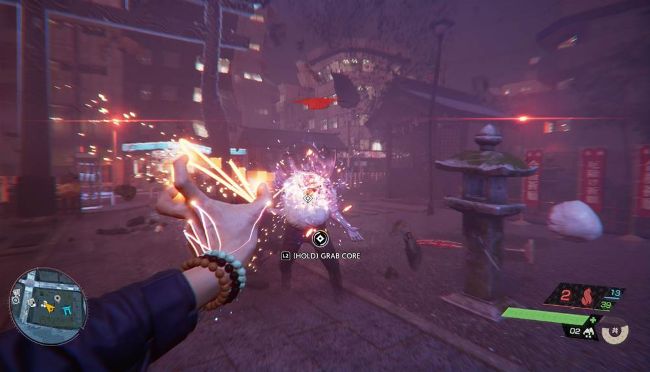
Combat
has
familiar
rhythms,
beneath
the
magic:
match
the
right
element
or
ability
to
the
right
opponent
and
then
wait
for
openings
in
order
to
knock
the
yokai
off
balance.
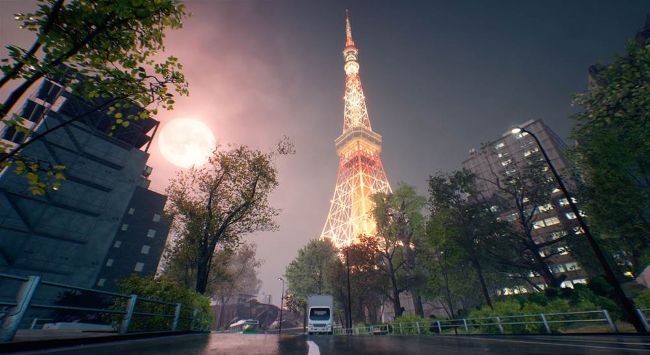
There
is
a
touch
of
Tom Clancy’s The Division to Ghostwire’s setting, with eerie scattered clothing in place of the former’s heaped bodybags
It’s a recipe for some bruisingly esoteric melee combat, cobbling together inspirations from judo, firstperson shooters and ancient Buddhist exorcism rituals. But Ghostwire is just as enticing as a game’s worth of spooky stories and urban legends. It’s a dense sandbox with its sights firmly set on the supernatural architecture nowadays obscured by ‘high’ technology and armies of commuters. As such, it’s also an opportunity for Tango to rediscover its home city as it ventures beyond The Evil Within.
Prominent among Tokyo’s otherworldly structures are torii gates: free-standing, straight or recurved structures that draw the line between realities. “They were thought to be gates that connected this world to the other world,” game director Kenji Kimura explains. “And so for shrines, it’s kind of like outside the gate is just normal life, but anything within is sacred ground.” There are hundreds of these gates in the city, some arranged into staggered, vermillion tunnels. They are marks of tradition that have not only been preserved but in some cases elevated as Tokyo’s skyline has risen.