SOUL REBEL
VARIOUS HOLLYWOOD HOT-SHOTS HAVE TRIED AND FAILED TO MAKE A BIG-SCREEN BIOPIC OF REGGAE'S GREATEST SUPERSTAR, BUT NOW, BOB MARLEY: ONE LOVE HAS ARRIVED. DIRECTOR REINALDO MARCUS GREEN AND HIS CAST TELL US HOW THEY FINALLY FOUND THE MAN BEHIND THE MYTH
WORDS AL HORNER
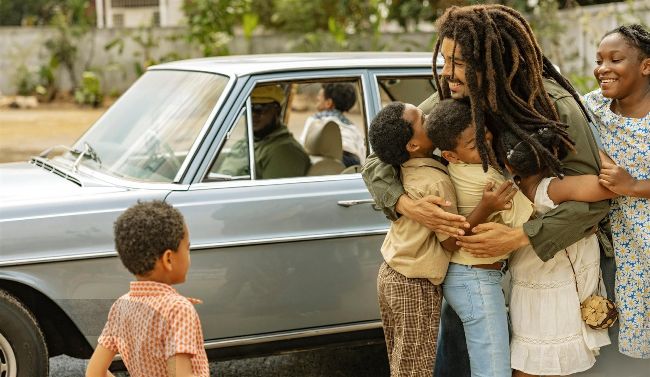
Bob Marley (Kingsley Ben-Adir) spreads the love
REINALDO MARCUS GREEN wanted to know who the man was on all the T-shirts. On all the murals, on all the posters, on all the biographies that took up entire shelves in bookshops. His entire life, he’d been staring at his image: at the man’s gleaming smile, knotted dreadlocks, his languid frame, often decked in the green and yellow colours of his motherland. His entire life, he’d heard the man’s voice, ever-present on the stereo in his Staten Island home growing up. Now, he wanted to know who this stranger was.
On the one hand, of course, he knew. Who doesn’t know Bob Marley? “After Jesus, he’s probably the most recognisable face on the planet,” laughs the director —a suggestion that only seems outlandish until you try to disprove it. Who else in music history is as synonymous with an entire genre (reggae), an entire nation (Jamaica), an entire religion (Rastafarianism) and even an entire recreational drug (sorry to break it to you, Snoop Dogg)? “Bob is uniquely universal. But I still felt like I didn’t really know him, and that few people really do,” continues Green, whose drama Bob Marley: One Love — a biopic 30-plus years in the making —attempts to set the record straight, reminding the world of the musician’s political radicalism.
“The idea of Bob that exists in university campus dorms and in general throughout the West —it’s an image based on tiny soundbites. Soundbites that a lot of people don’t really understand,” says Kingsley Ben-Adir, the British actor with the not-at-all-daunting task of portraying the roots-rock legend. James Norton, who plays Marley’s long-standing manager Chris Blackwell, agrees: “When you talk about Bob Marley, the legend has become much bigger than the man.”
When many people think of Marley, they think of reassuring lyrics about how “every little thing is going to be alright”, as he sang on 1977’s ‘Three Little Birds’. They think of quotes he gave in interviews, circulated today on Instagram with images of sunsets, about peace and love and unity. They think of merchandise —the endless merchandise, from official Primark T-shirts and official energy drinks (‘Marley’s Mellow Mood’) to official ‘Get Up, Stand Up!’ iPod docks, available in three different colours. They might think of marijuana, too: in 2015, a Saturday Night Live segment laughed at the “cruel twist” of a real-life New York University course titled ‘Bob Marley And Post-Colonial Music’ being taught at 8am, the implication being that his fans are stoned slackers too lazy to get out of bed before lunch.