DESIGN A VIDEO GAME WEAPON
AUTHOR
Mike Griggs Mike Griggs is a veteran creator with a passion for explaining the process of digital content creation to new artists. www.creativebloke.com
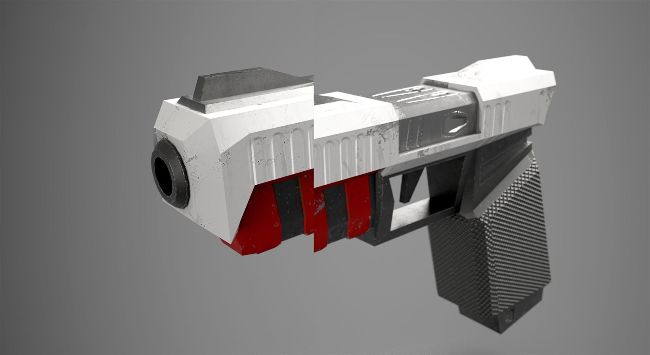
Modelling – N-gons Throughout the model, I ensured it was created with quad (4) sided polygons. Doing this means that model conversion between 3D apps is consistent. What was not desired were N-gons, which are polygons with more than four sides. I made sure that the modelling viewport HUD (accessed via Shift+V) had the 'Polys' and N-gons numbers shown. This meant I could see if I was under my polygon budget of 1,000 and also if I had any N-gons. These could then be hunted down, usually found by switching to vertices mode and seeing if any vertexes were in the middle of an edge.
Creating a bespoke solution for a complex problem is at the heart of any 3D model, scene or animation. The trick to becoming a successful 3D artist is understanding that the ‘complex problem’ changes for the type of output that is required.
A good example is creating 3D assets for games, whether animated or to be used as a static prop. Linear animation or VFX tend to need highly detailed assets and have multiple complex systems for animations, such as muscles, dynamic skin, etc. All of these elements will be utilised in the compositing phase after a render. Some of these animation requirements are being used in the latest AAA+ games. Most games, though, need more straightforward solutions, as a game asset never has a ‘final render’ and is ‘live’ all the time it is being interacted with.
When creating game assets, the first priority should always be efficiency. The good thing about learning ‘efficiency’ in 3D creation is that this will reap dividends no matter what type of assets you are creating.
So what do we mean when we talk about efficient creation? Let’s start with the fundamental truth about any game asset. The game asset likely needs to be exported from the 3D creation software to a game engine. To do this, the asset needs to be in a format that can be exported and imported. Additionally, the asset also needs to have as simple a structure as is possible, whether it be a single mesh or a series of multiple meshes. This structure should be named in a way that is clear when imported into the game engine, or if the model creation file is being accessed by another artist.