THE EVOLUTION OF DOOM
AS NOTABLE FOR ITS GENRE-PEFINING PESIGN AS ITS GROUNPOREAKING TECH, DOOM REPEFINED THE FPS AND DEGAN AN EPIC FRANCHISE, DOOMGUYS JOHN ROMERO, JONATHAN MOSES, ROBERT DUFFY AND JASON O'CONNELL EXPLAIN HOW IP'S HELL-RAISING SERIES EVOLVED
WORDS BY RORY MILNE

■ During his id days John Romero revolutionised the FPS with titles like Doom and Doom II. He now runs Romero Games.

■ Jonathan Moses produced Doom 3 for Activision. He is now director, games partnerships at OneTeam Partners.
There’s a certain symmetry to the fact that a game as influential as id Software’s first-person shooter
Doom
took influence from a number of sources itself. In terms of tech and gameplay, Doom owed much to the long line of FPS titles that id had created previously. This lineage arguably began with the 1991 release of Hovertank One, even if its hero drove a tank rather than being on foot. It certainly included id’s spell-casting fantasy from the same year Catacombs 3-D and the studio’s 1992 Nazi-battling shooter Wolfenstein 3D.
In terms of Doom’s theme, objectives and coolest weapon, id looked to its epic RPG sessions and to the silver screen, as Doom designer John Romero explains. “Catacombs 3-D was basically the first FPS, then with Wolfenstein 3D we added weapons,” John remembers. “So with Doom, Wolfenstein 3D was our baseline, but there were so many massive leaps. Not least that Doom’s world changed what games looked like from then on. You went into space and found Hell instead of aliens; the idea of overrunning a space base with demons was from our D&D campaign. That hoard of demons coming at you from all over the place was from Aliens, and then the shotgun came from Evil Dead II.”
“WITH DOOM, WOLFENSTEIN 3D WAS OUR BASELINE, BUT THERE WERE SO MANY MASSIVE LEAPS. NOT LEAST THAT DOOM’S WORLD CHANGED WHAT GAMES LOOKED LIKE FROM THEN ON”
JOHN ROMERO

■ Doom 3 lead coder Robert Duffy also worked on many subsequent Doom releases. He left the games industry in 2024.

■ Saber Interactive’s Jason O’Connell defined the missions for the 2016 reboot of Doom and the levels in Doom Eternal while working at id.
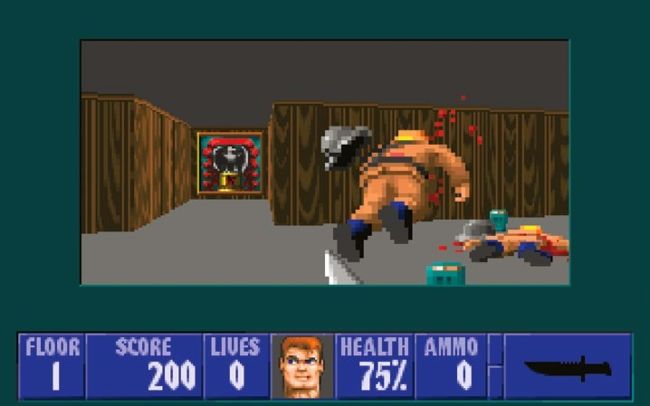
» [PC] Despite their thematic and stylistic differences, Wolfenstein 3D laid the foundations for Doom.
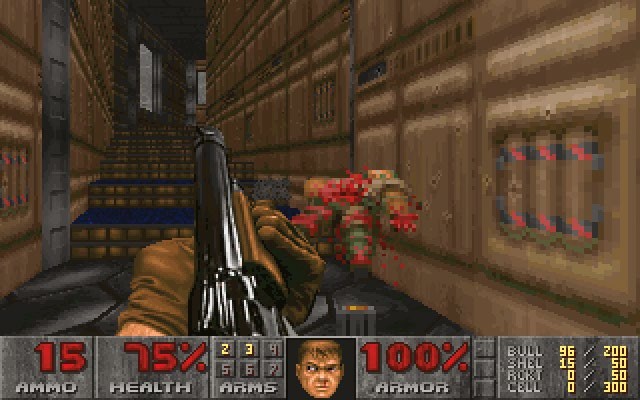
» [PC] There’s very little that’s more satisfying than taking opponents out in Doom with the shotgun.
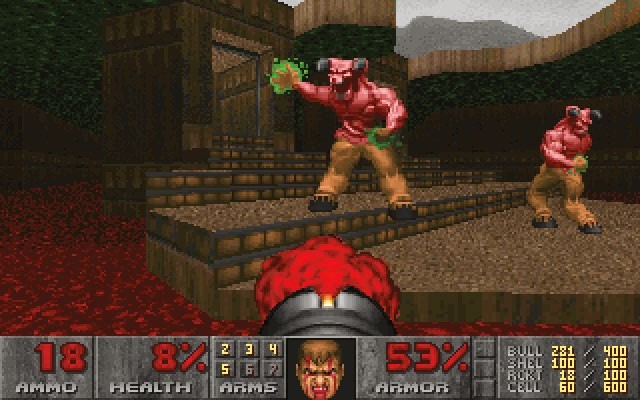
» [PC] As tough as the typical monsters are in Doom they’re nothing compared to the bosses you encounter.
Far from being Doom’s only weapon, its shotgun was just one of many swappable armaments that could be found in the game. These sat on a sliding scale that reflected how much damage they could do, with the most effective option being perhaps the least likely one, as John points out. “The weapon balance was really important; we wanted a design that valued every single weapon,” John considers. “We wanted to have visceral kills, we wanted blood and explosions, so we stuck to conventional weapons. You used your fists as a last resort, so then why not power them up with a Berzerk? It changed the punch from the weakest hit into the hardest hit. The goal was survival, if you wanted to you could 100% the levels, but getting to the exit was more important than killing everything.”
This single-player objective was tweaked for another of
Doom’s
modes, more specifically its deathmatches, a term coined by John to describe a multiplayer experience where players killed each other’s space marines over and over again. But while multiplayer was always intended for Doom, it ended up as a last-minute addition. “We knew when we were planning Doom that we needed multiplayer in there. Then when it was, the first thing we did was shoot each other, even though it was supposed to be co-op!” John exclaims. “Not once did we think that we needed to make deathmatch-only levels. We didn’t have time. We actually forgot about multiplayer until October 1993, and Doom was due out that December. The word deathmatch, well I just thought that since it was a match to the death why not call it a deathmatch?”
Adopting the shareware model, Doom was released as three episodes in 1993, with the first being free to download and the others being sold via mail order. The massive success of Doom’s three episodes guaranteed a sequel, but Doom II would be released as a single product at retail. “We weren’t trying to market three episodes; we were selling Doom II, so there was no reason why we should have that separation,” John reasons. “But we put intermissions in because we wanted to give the player a break and a bit of narrative. Those didn’t change anything, they just meant that a level ended and then a new one started with the same items. So you got to go longer with the weapons, but the enemies got harder, so you kind of needed to keep your weapons.”