GB
  
You are currently viewing the United Kingdom version of the site.
Would you like to switch to your local site?
11 MIN READ TIME

Q&A

A selection of historical conundrums answered by experts

How did the ancient Egyptians believe that the world began?

The ancient Egyptians – the civilisation that flourished on the banks of the Nile from c3100 until Cleopatra’s death in 30 BC – recognised about 1,500 gods. Their many cults provided varied explanations for the creation of the world, all considered equally valid. These followed the same basic plan: a chaotic time before creation was followed by the emergence of a creator god who made other gods and people and, in so doing, created order. However, the method described varied from cult to cult.

A person living in Memphis (now south of Cairo) would have learned the creation story featuring the craftsman god Ptah. Having created himself using intelligence and the spoken word, Ptah created the gods and the people. Someone living at Hermopolis Magna (al-Ashmunein) would learn from the priests of Thoth; for them, life started with four frog-headed gods and four snake-headed goddesses swimming in the primeval waters until a celestial goose laid an egg on a ‘Mound of Flame’. On the island of Elephantine (Aswan), it was believed that the gods, people and their souls were created from mud by the ram-headed potter god Khnum.

The best-known creation myth belongs to the cult of the sun god Re of Heliopolis (northern Cairo). In the beginning, nothing existed but the waters of Nun. Deep within Nun there floated an egg holding a spark of life. Suddenly the egg cracked open and a mound rose up. Seated on that mound was Atum, god of light. Atum used his body fluids to create twin children, Shu (atmosphere) and Tefnut (moisture). The twins produced Geb (earth) and Nut (sky); this brother and sister then became the parents of the powerful deities Osiris, Isis, Seth and Nephthys. Meanwhile, Atum cried, and his tears became the people of Egypt.

Professor Joyce Tyldesley, University of Manchester
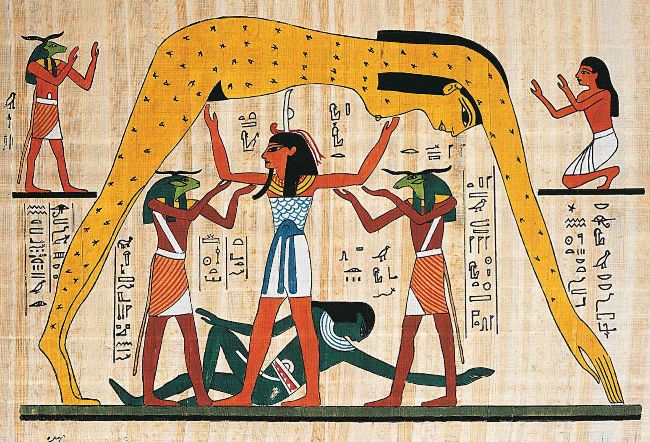
A reconstructed tomb fresco depicts the Egyptian sky goddess Nut arched over her brother Geb (reclining), while held up by their father, Shu – all key figures in an ancient Egyptian creation myth

When did Persia become Iran?

Unlock this article and much more with
You can enjoy:
Enjoy this edition in full
Instant access to 600+ titles
Thousands of back issues
No contract or commitment
Try for 99p
SUBSCRIBE NOW
30 day trial, then just £9.99 / month. Cancel anytime. New subscribers only.


Learn more
Pocketmags Plus
Pocketmags Plus

This article is from...


View Issues
History Extra Magazine
April 2025
VIEW IN STORE

Other Articles in this Issue


BBC History
THIS ISSUE’S CONTRIBUTORS
Jonathan Healey “The Civil Wars are endlessly
ROYAL RESIDENCES Secrets and scandals
Become an instant expert with our six-week course
Editorial
WELCOME
APRIL 2025
EVERY MONTH
An Islamic army lands in Gibraltar
27 APRIL AD 711
Apollo 13 faces catastrophe
The lives of three astronauts hang in the balance during their ill-fated lunar mission
A photo of the Loch Ness Monster is published… or is it?
The ‘Surgeon’s Photograph’ fuels a media frenzy
Sacagawea helps forge a path of discovery
An Indigenous teenager accompanies Lewis and Clark across America
“If the culture wars were to come to an end, historians would be delighted”
EXPERTS DEBATE HISTORY’S BIGGEST ISSUES
Marika Sherwood (1937–2025)
The pioneering historian, author and campaigner Marika Sherwood
“Why Elon Musk should take a lesson from Confucius”
MICHAEL WOOD ON… EPIC MEDIEVAL CHINESE VOYAGES FRAN
“Some say that the first Jews sailed to India on King Solomon’s ships”
HIDDEN HISTORIES KAVITA PURI on the long-standing but
THIS MONTH’S TOP PODCAST PICKS
Listen ad-free at historyextra.com/podcast or with ads wherever you get your podcasts
LETTERS
LETTER OF THE MONTH Evacuee memories Dan
“We tend to take all of the prejudices of a previous era, frozen in aspic, and regurgitate them”
INTERVIEW / HALLIE RUBENHOLD
Shock and awe in the Renaissance
RENAISSANCE
ON THE PODCAST
The Renaissance
Trail of thought
RELIGION
Divided loyalties
RONALD HUT TON is impressed by a look at the lives of two men riven by the conflict between king and parliament
THE CLASSIC BOOK
Levi Roach on a groundbreaking look at medieval culture and history
Infectious material
MEDICINE
Charms and crosses
The Magic Books ALAMY by Anne Lawrence-Mathers Yale University
Shade stories
Pink: The History of a Colour by Michel Pastoureau
ENCOUNTERS
HISTORY COOKBOOK Easter simnel cake HISTORIC CITIES
Easter simnel cake
RECIPE
Beijing in five places
HISTORIC CITIES
PRIZE CROSSWORD
Across 1 Battle of ____ Hill, February 1881,
NEXT MONTH
May issue on sale 17 April 2025
Andrei Sakharov
1921– 89
FEATURES
WE PROVED, WITH 99.999% CERTAINTY, THAT THE SKELETON IN THE CAR PARK WAS RICHARD III. HERE’S HOW
Turi King led the verification team that worked on Richard III’s rediscovered remains. Here, on the 10th anniversary of the king’s reburial service, she reveals how science finally solved a 500-year-old cold case
Robert Wedderburn Firebrand abolitionist
While most British radicals fought for the rights of the exploited white working class, one man saw such rights as entwined with those of enslaved black workers. RYAN HANLEY tells the story of the ‘notorious firebrand’ who campaigned against slavery
“Matchless monsters of the female sex”
Men committed most violent crimes in Tudor and Stuart England. But when women murdered, the press had a field day. Blessin Adams asks what drove society’s gleeful fascination with its “angels of death”
WHAT TO DO WITH THE DEAD?
Tens of thousands of British and German servicemen died on enemy soil during the two world wars. What happened to their remains, writes Tim Grady , tells us a great deal about the two nations’ evolving relationship after the conflicts
Was Charles I truly a tyrant?
THINK PIECE
FIVE THINGS YOU (PROBABLY) DIDN’T KNOW ABOUT… the history of pirates
Sophie Nibbs shines a light on the murky world of the bandits who marauded the high seas in the 17th and 18th centuries
Josephine Baker DANCER, ACTIVIST, SPY
Today she’s widely remembered as a risqué entertainer – yet she was also involved in many of the earth-shaking events of her era. On the 50th anniversary of Josephine Baker’s death, Anna Maria Barry tells the story of a true 20th-century icon
BOOKS
RENAISSANCE “If you want to understand why people
Chat
X
Pocketmags Support