HELLRAISER
SOMETHING WICKED THIS WAY COMES
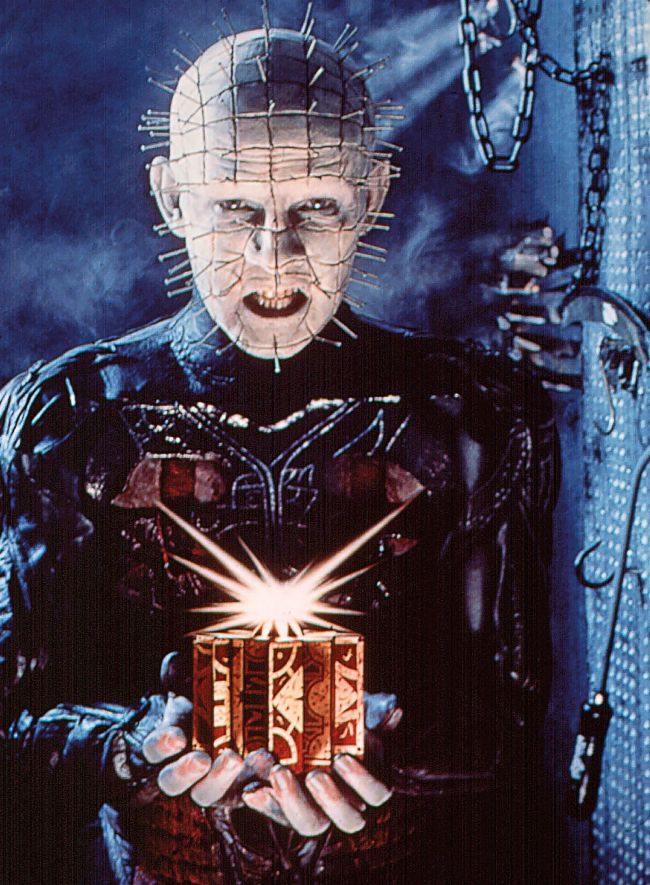
Nightmarish. Disturbing. Transgressive. Weird. Hellraiser was the twisted fantasy horror that gave the world Pinhead and influenced generations of metal bands
WORDS: EMMA COWNLEY
MOVIESTORE COLLECTION LTD/ALAMY STOCK PHOTO
It’s the autumn of 1987, and actor Doug Bradley is on the phone to his childhood friend, the author Clive Barker. They’ve just finished working together on a low-budget horror film called Hellraiser. It’s Doug’s first film role and Clive’s directorial debut. Although the actor’s part is small, his nightmarish character, Pinhead, dominates the movie’s poster.
“He was calling me from the back of a car in Los Angeles,” recalls Doug today. “He was saying, ‘Just wanted to let you know, you’re currently 30 feet high over Sunset Boulevard for your first job.’ I thought, ‘Well, that’s cool, but it’ll all be forgotten about fairly soon.’”
He couldn’t have been more wrong. A cult hit at the time, Hellraiser’s status as one of horror’s greatest and most unsettling movies has only grown in the 35 years since it was released. A nightmarish, occasionally surreal story of a man who trades his soul for “an experience beyond limits” only to be swallowed into a hellscape where he’s torn apart by demonic entities called Cenobites, it was totally different to the mainstream horror of the time. Its interdimensional sex torture wasn’t for everybody, but it connected with those whose tastes veered towards the strange and the transgressive – not least within the metal community.
In the 35 years since its release, Hellraiser’s story, visuals and aesthetics have inspired bands from Ministry to Cradle Of Filth.
“What I love about it is it has a very fairy tale element”, says Cradle of Filth frontman Dani Filth. “It’s the whole Narnia-type scenario, gone to Hell.”