HOW TO MODEL BRATTON FLEMING STATION
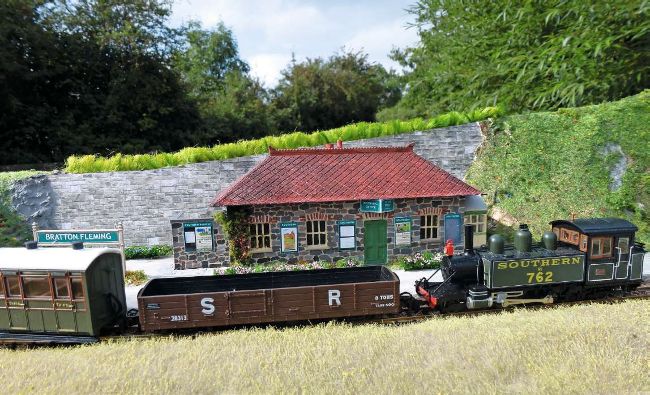
PHOTOGRAPHY:CHRIS LEIGH
It might seem strange to start a feature about Bratton Fleming station with a photograph that does not actually illustrate the station, but here’s why.
Of all the pictures that I have of the Lynton & Barnstaple Railway, this picture, from a tiny contact print, is the one which best evokes the L&B to me. It is from the collection of my friend and mentor, Alistair B. MacLeod, who was locomotive running superintendent at Eastleigh, responsible for the L&B in its final years. However, ‘Uncle Mac’ did not take the photograph, as a note in pencil on the back reads ‘ABMcL on footplate’.
He was probably firing, as he told me, on a number of occasions, that he did not like firing the Manning Wardle 2-6-2Ts because he was tall, and the firehole was small and close to the floor, forcing him to stoop. The photograph shows the wonderful Devon scenery through which the contractor has had to cut deeply, a miscalculation which caused his business to fail and deprived the L&B of the early maintenance which was included in the contract.
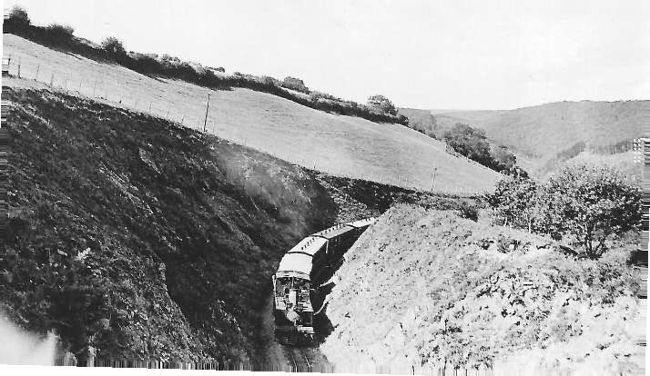
With scarcely a month left to operate, one of the Manning Wardle 2-6-2Ts – probably No. 759 Yeo, climbs between Bratton Fleming and Blackmoor on August 22 1935.
A.B. MACLEOD/CJL COLLECTION
The 2-6-2T will have been working hard on the 1-in-50 gradient which began near the 4-milepost from Barnstaple and continued with little respite through Chelfham, and Bratton Fleming to Blackmoor Gate, almost eight miles later.
Nestling under a wooded hillside some 7½ miles from Barnstaple was the small station at Bratton Fleming, a village some little distance away from the railway. The Southern Railway built its Barnstaple Town station beside the River Taw as the cross-platform junction station for the L&BR, which opened in 1898.
The halt at Snapper and the first two small stations, Chelfham and Bratton Fleming, were constructed by the contractor. The larger Swiss chalet-style stations at Blackmoor, Woody Bay and Lynton were built by a local builder, Jones of Lynton, the station at Lynton being quite substantially altered by the Southern Railway after their takeover of the L&B at Grouping in 1923.