THE TRUTH IS OUT THERE
CHAOTIC, INTENSE AND DISBANDED ATTHE HEIGHT OFTHEIR POWERS BY THEIR FREAKED-OUT MAINMAN, NEUTRAL MILK HOTEL’S CULT STATUS WAS INSTANTLY ASSURED. NOW A NEW BOOK ABOUT THE BAND AND THEIR ECCENTRIC ELEPHANT 6 ALLIES DIGS DEEPER INTO THE MYSTERY. “THERE WERE MOMENTS OF REAL BEAUTY, AND THERE WERE MOMENTS OF REAL DESPAIR,” DISCOVERS ITS AUTHOR, ADAM CLAIR.
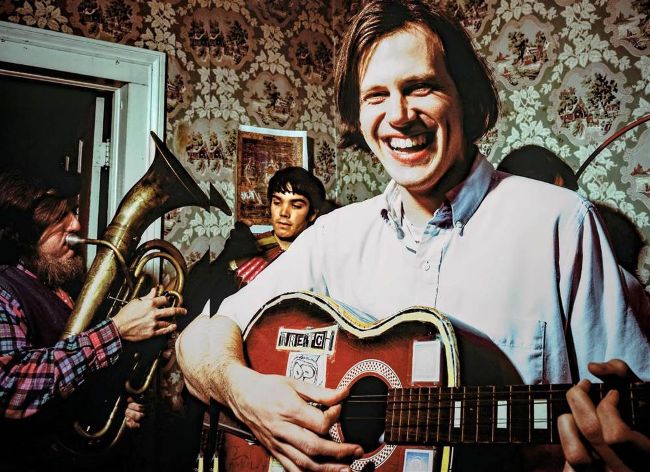
Room at the inn: Neutral Milk Hotel (from left)
Scott Spillane, Jeremy Barnes, Jeff Mangum and (obscured) Julian Koster.
PHOTOGRAPH: CHRIS BILHEIMER
BY THE END OF 1998, NEUTRAL MILK HOTEL was among the most promising indie bands in the world. They had performed nearly 100 times that year, across the United States and 10 other countries. Tickets sold well, and those who stuck around long enough – they were not an especially punctual band and often took the stage hours after their listed set time – eventually turned what they saw into a legend: a singular band at its peak, a transcendent, you-justhad-to-be-there, too-bad-you-weren’t performance. Many report having been moved to tears. A&R reps from major record labels took notice, too, and had begun sniffing around.
Led by Jeff Mangum (guitar, voice) and comprising Jeremy Barnes (drums), Scott Spillane (guitar, brass) and Julian Koster (accordion, saw, etc), plus supporting members including Laura Carter and Robbie Cucchiaro, the band were touring in support of an album, In The Aeroplane Over The Sea, they had released that February.
Today, it’s hailed by music website Pitchfork as the fourth-best record of the 1990s, beating Nevermind and The Bends. Its title track alone has been streamed more than 80 million times on Spotify, and the physical LP remains a top seller ever y month in record stores around the globe.
Neutral Milk Hotel seemed poised for whatever next step Jeff Mangum wished to pursue, though no one really expected or understood what he did next. After a New Year’s Eve 1998 show at the 40 Watt Club in Athens, Georgia, attended mostly by friends,
Mangum hit the eject button. He stopped releasing new music or doing inter views. He never said why he was stopping, or even that he was stopping, not even to his own bandmates. This radical act of negation has become one of the most baffling mysteries in music histor y. After all, who wouldn’t want to be a rock star?
FROM THE BEGINNING OF MANGUM’S HIATUS, rumours abounded about his reasons for stepping away, usually some version of “he went nuts” because of In The Aeroplane Over The Sea or the quasi-religious fandom that grew around it. Yet those who know him best say it means a lot to him that the record is so meaningful to so many. Not that he isn’t a little shy.
“I see that he’s really touched when people come to talk to him and stuff like that,” longtime friend and collaborator Robert Schneider says. “Like if I’m with him and a person comes up to him and talks to him, he’ll draw them a little picture or something like that. He’s so kind. And then after wards, he looks all like, That was nice. But if it’s three people, suddenly it feels like a barrage, and he’s looking for the exit.”
Mangum and Schneider have been friends since they were seven years old, crossing paths in second grade in a Ruston, Louisiana school for the children of professors at Louisiana Tech University. In the early ’90s, along with a few of their friends, they co-founded Elephant 6, a collective of ambitious, idealistic weirdos with an unfashionable obsession with psychedelic pop, out of which launched Mangum’s Neutral Milk Hotel and Schneider’s Apples In Stereo as well as the Olivia Tremor Control, Of Montreal, The Minders, Elf Power, and dozens more incarnations.