A YEAR IS A LONG TIME IN POLITICS
Since becoming FIA president, Mohammed Ben Sulayem has caused controversy at every turn. Andrew Benson looks back over a troubled leadership and asks what his change of role means for 2023
F123
FIA president Mohammed Ben Sulayem
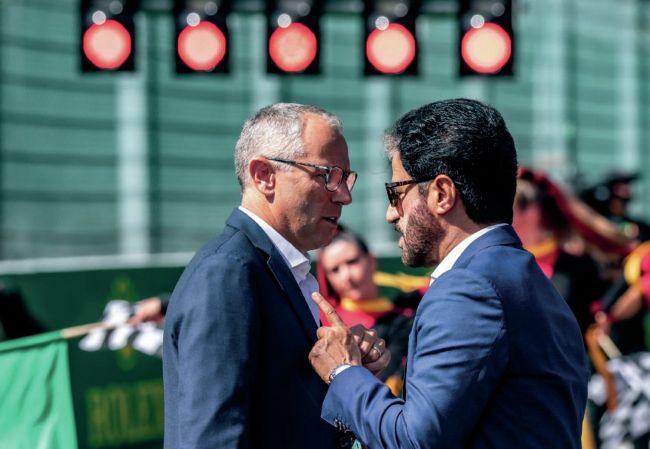
A war of words broke out between
F1 CEO Stefano Domenicali,
Formula 1 is used to conflict – between drivers, between teams, between the teams and the governing body. One might almost say the sport thrives on it. But not for more than 30 years has there been open warfare between the FIA and the company that makes F1’s money. Until now, that is.
The way Mohammed Ben Sulayem has conducted himself as FIA president has been causing disquiet since he took the position in the immediate aftermath of the controversial climax to the 2021 world championship.
His second year in office is still young. But over a few short weeks in the new year, disquiet turned to something more severe, to the extent that some in F1 were beginning to wonder whether having Ben Sulayem heading the governing body was a sustainable proposition.
The path to this point had been strewn with controversies, most of them kept relatively low-key. But in January Ben Sulayem made a move that so angered commercial rights holders Liberty Media and its F1 company that their chief legal officers sent an explosive letter to the FIA Executive and World Motor Sport Council to complain.
Ben Sulayem had “interfered with our rights in an unacceptable manner”. He had “overstepped the bounds of both the FIA’s remit and its contractual rights”. The FIA “may be liable” for any damage to Liberty’s share value, it concluded. It was an extraordinary intervention in the relationship between two parties that are supposed to work together in the stewardship of motor sport’s top category, and it left many wondering what comes next.
The issue that so incensed F1 was a series of tweets Ben Sulayem posted in response to a news report claiming that Saudi Arabia’s Public Investment Fund had tried to buy F1 for $20bn (£16.6bn). Ben Sulayem referred to this as an “inflated price tag”, adding that “any potential buyer is advised to apply common sense, consider the greater good of the sport and come with a clear, sustainable plan – not just a lot of money”.
His intervention raised many eyebrows in F1. What was he trying to achieve, people wondered? Why had he seen fit to speak publicly on a commercial matter, which is F1’s domain both traditionally and contractually? Also, why did he not trouble to ask F1 whether the story was accurate? Sources, incidentally, say it was not. The Saudis are a major sponsor of F1 and host a race. They are interested in the idea of potentially buying F1. But there is said to have been no official Saudi bid and in any case Liberty has absolutely no intention of selling for the foreseeable future. The sport, as F1 chairman Stefano Domenicali put it, is Liberty’s “jewel”.