YOU CAN BECOME A HUMAN SPRING
DEVELOPING LOWER-LIMB STIFFNESS IS ESSENTIAL FOR GREATER SPEED, POWER AND SPEED ENDURANCE, WRITES JOHN SHEPHERD
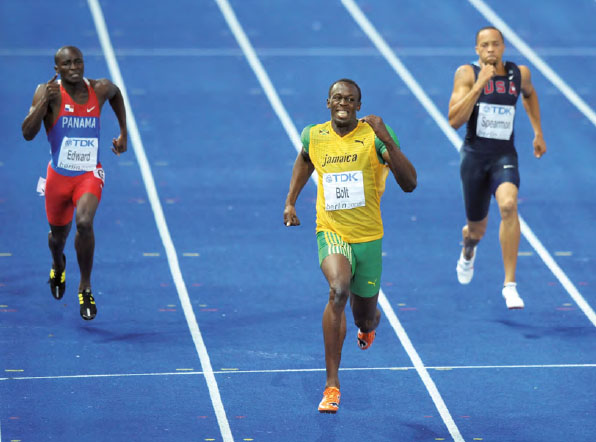
Usain Bolt in Berlin in 2009: stride length and frequency can offset a relative lack of leg stiffness
MARK SHEARMAN
IN THE sprints, hurdles, throws and jumps events, power and speed are obviously paramount. An athlete in these events may have the best technique, but unless they can generate and apply force rapidly then they are not going to maximise their potential.
‘Athletic horsepower’ is all about overcoming resistance. An obvious example is the high jumper who needs to overcome gravity to soar skyward. It appears that athletes who are able to generate the most power have the most effective human springs – an ability which the sports scientists say reflects lower limb stiffness.
Adding spring
Simply put, an athlete wants to have limbs – or more specifically muscles, ligaments and tendons around the relevant joints and even cartilage and bone – that are able to produce maximum power usually in the shortest amount of time. This is certainly the case for sprinters, sprint hurdlers and horizontal jumpers.
High jumpers and throwers, for example, may need to moderate their speed to an optimum performance-producing level. Sprinting flat-out to throw the javelin, or perform a high jump take-off, for example, is unlikely to result in the most effective throw or jump. Nevertheless, their ability to ‘fire’ their leg muscles quickly is very important. This relies very much on lower limb-stiffness – from now on in this article referred to as stiffness.