RYZEN AGAIN THE RESURRECTION OF AMD
Five years ago, AMD nearly went to the wall. Now, it has the edge on Intel and Nvidia, and billions in the bank. Jeremy Laird investigates its dramatic resurgence
MAKE A NOTE of the date, 22nd February 2022. That was the day AMD’s market capitalization— essentially, its overall value as a company—surpassed Intel’s for the first time. It was nothing less than a spectacular reversal in fortunes for a company that had been on the very brink just a few years earlier. Forget wondering whether AMD can even survive, it is now an entirely legitimate question to ask whether AMD can overturn Intel’s dominance of the PC. Truly, AMD has become the pretender to Intel’s throne.
Of course, stock prices don’t tell you everything about a company’s real-world proportions. Intel still has a 75 percent market share for PC processors and generates massively more revenue and profit than AMD. But the notion of AMD as the usurper of Intel’s position as the predominant purveyor of PC processors and platform technology is now more plausible than ever.
How, exactly, did AMD turn it around? Now that’s a question. As we’ll see, a little bit of luck didn’t hurt. But as the saying goes, you make your own luck and there’s absolutely no denying the heightened competence and consistency with which AMD has been led since Lisa Su took over the company in 2014.
All told, AMD’s recovery from near oblivion makes for a fascinating story of corporate and technological rejuvenation.
UNDENIABLY INTIMATE. Often symbiotic. And occasionally parasitic. Such has been AMD’s relationship over the decades with its greatest rival, Intel. Truly these are two companies with a shared destiny. The story of AMD begins way back in 1969. Inevitably, Intel looms large right from the start. AMD was founded by eight former employees of Fairchild Semiconductor and headed up by none other than Jerry Sanders, former marketing boss of Fairchild and the leading figure in AMD’s early years. It was only 12 months earlier that Robert Noyce and Gordon Moore also left Fairchild to set up... you guessed it, Intel.
Both companies set out to make an impact in the nascent integrated circuits business, otherwise known as computer chips. But from the start, they took different paths. Intel went heavy on the R&D to create its own designs, while AMD opted for the quicker and less expensive route to market by being a so-called second source supplier of microchips designed by Fairchild and National Semiconductor.
Second sourcing is all about securing reliable component supply and not depending on just one company. You can read how AMD went from a second source supplier of IBM-compatible CPUs to sharing full access to Intel’s allimportant x86 instruction set in the boxout on page 37. But suffice to say, by the early 1980s, AMD was carving out a niche as the leading alternative to Intel in the PC processor market.
Intriguingly, AMD was much more competitive during this early period than the standard narrative of perennial underdog allows. The usual refrain around AMD’s latterday success with its current Zenbased CPUs involves the mighty K8 series, the architecture that underpinned the Athlon 64, as the only substantial example of AMD getting one over on its archnemesis. But the real story is much more complicated than that.
As early as 1984, AMD was manufacturing Intel’s 286 processor as a second source supplier to IBM but achieving up to 20MHz clockspeeds whereas Intel’s in-house chip topped out at 10MHz. The 386 era was something of a hiatus as AMD and Intel feuded over rights to the x86 ISA, but when AMD eventually managed to reverse engineer the Intel chip, just like the 286, AMD’s take on 386 outclocked its Intel rival.
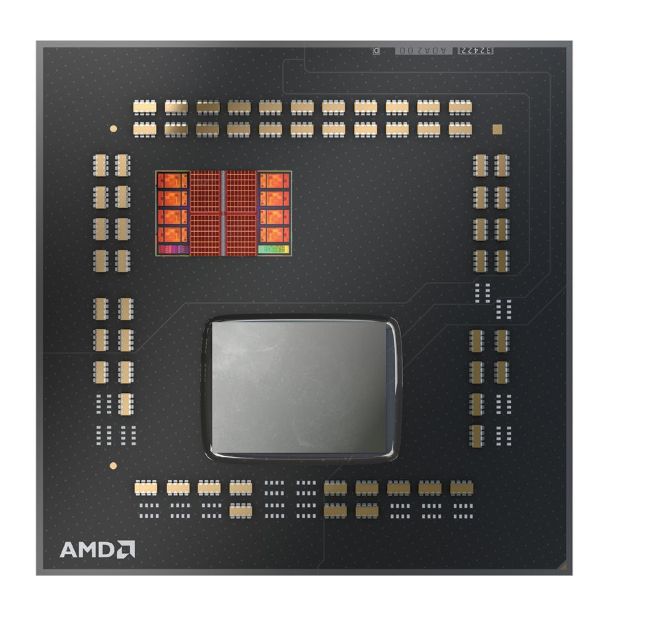
AMD’s Zen 3 architecture is keeping Intel’s latest Alder Lake CPUs honest.
It wasn’t until the Pentium era in the mid-1990s, however, that AMD attempted its own true in-house design, the ill-fated K5. Arguably AMD’s first major failure, K5 arrived later than planned in 1996, missed its clockspeed targets, and generally couldn’t compete with Intel’s then protagonist, the Pentium Pro. AMD recovered with the K6 the following year and kept Intel honest right through until late 2003, often landing significant blows with chips like the K7, otherwise known as the first Athlon processor, but never quite knocking Chipzilla out. That brings us to a pivotal moment in AMD’s history, the arrival of K8, the mighty Athlon 64.
Codenamed Clawhammer, the Athlon 64 was the first desktop CPU to deliver 64-bit instruction capability to the desktop. Not only that, but it also delivered outstanding per-clock performance at a time when Intel’s Pentium 4 Netburst architecture was hitting a frequency wall. Once intended to scale all the way to 10GHz, Intel found clockspeed gains increasingly tough beyond 4GHz. The Athlon 64 wasn’t just competitive, it absolutely trounced the Pentium 4.
K8 was killer in server systems, too, thanks to its advanced integrated memory controller and HyperTransport interlink, which made Intel’s Front Side Bus