The Kellerific Effect
‘Fairness’ and ‘family’ are two values taken for granted in international rowing. Thomi Keller dedicated thirty years of his life to securing them. Christopher Dodd on the FISA president who fought the good fight in the Olympic arena
Words CHRIS DODD
It is almost 30 years since the death of Thomi Keller. Three generations of rowers have thus grown up without experiencing the powerful oratory, wry humour, rasping admonishment or whooping joy from the towpath of a president who for more than thirty years led rowing, its international federation and, arguably, the Olympic Games to a better place.
Born into a well-to-do Swiss family on Christmas Eve 1924, Thomi became fatherless when he was six. His father Max was tragically killed by a lion whilehunting near his sisal farm in Tanganyika (now Tanzania). The family settled in a former restaurant on a hillside overlooking the Zurichsee. Thomi tried football before becoming an accomplished ski-jumper and cross-country skier, and then in 1940 began sculling at Zurich’s Grasshopper Club, the start of a career that made him national champion and bronze medallist in the European championships in 1950. He studied chemical engineering at Zurich’s Polytechnic, married Dorry Bodmer, and in the early 1950s did a stint in the Keller trading house in Hong Kong and Manila. When he returned to Switzerland in 1954, he set his sights on sculling in the 1956 Melbourne Olympics.
Melbourne turned out to be the first of three game-changing events in Thomi’s life that were beyond his control. Shortly before departing for Australia, the Swiss oarsmen and participants in most other disciplines were pulled out of the Gamesin protest against the Soviet Union’s tankdriven crushing of the anti-Communist uprising in Hungary. The Swiss athletes argued in vain that withdrawal was not an appropriate way to protest against Russian aggression. Thomi was a signatory to the appeal to the Swiss Olympic Committee and became a prominent member of the ‘Melbourne Club’ of deprived athletes and the aircrew who would have flown them to the Games. The gymnasts who had favoured the boycott were not invited to the club’s get-togethers.
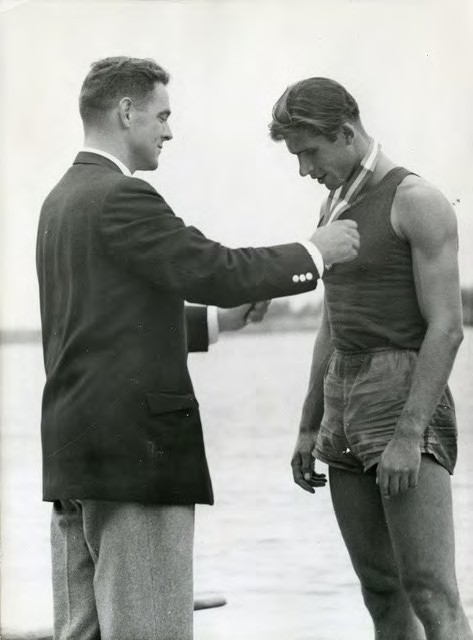
Keller presenting Soviet sculler Vietcheslav Ivanov with his winner’s medal at the 1959 European championships.
Thus began Olympic boycotts, and thus Thomi Keller lost his last chance to represent his country at the Games – and was poised to campaign against politics interfering in sport. Indeed, there were already quite enough political issues in sport itself for the pitch to be queered by world affairs.