How We Made
Roll as quick as you can to make it out alive from Kristian Amundsen Østby’s breathless co-op challenge. It’s time to face the music…
Words by Owen Duffy
ESCAPE THE CURSE OF THE TEMPLE
Players discover the temple’s changing layout as they reveal new tiles – and inevitably end up stuck in the rooms
For the most part, board gaming is a pretty laid-back hobby. While plenty of games explore action-packed themes of war, disaster or battles between giant robots, the actual act of play tends to involve sitting sedately around a table, following a set turn structure and patiently waiting for the chance to make your next move.
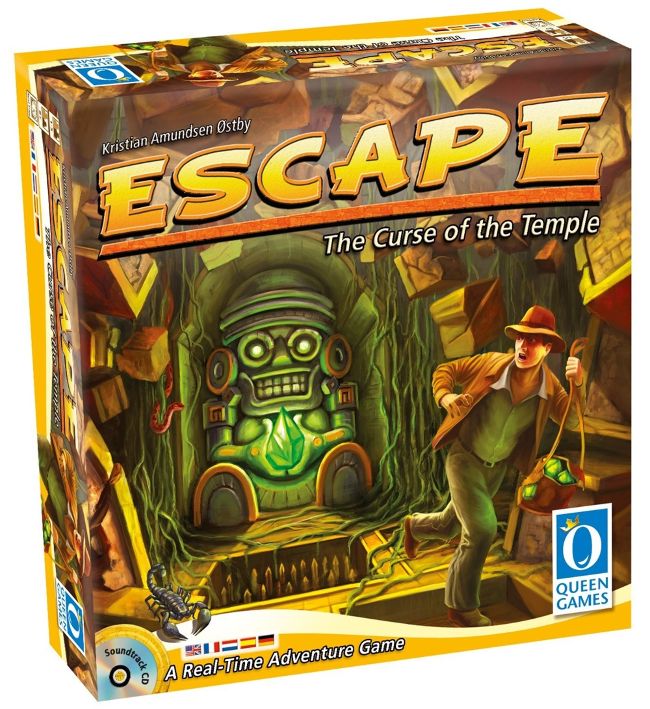
2012 release Escape. The Curse of the Temple turns all of those assumptions on their heads. A hectic game of co-operative dice-chucking, it’s raucous, unpredictable and packed with nail-biting tension. It hands players control of a party of adventurers trapped inside a lost shrine, and uses a combination of co-operative challenge and real-time gameplay to create one of the most exciting experiences you can have on the tabletop.
We spoke to its designer, Kristian Amundsen Østby, to uncover the secrets behind the game’s creation.
TICKING CLOCK
Growing up in Norway, Østby was exposed to games from an early age.
“As a kid I played a lot of different games,” he says. “I played whatever was available in the toy stores, and whatever I could find on the shelves when we travelled abroad. In the 1980s, the selection actually wasn’t so bad, as some Swedish publishers translated and distributed foreign games to Norway, so I played things like Hare & Tortoise, Ave Caesar, HeroQuest and Inkognito. Then I discovered American imported games such as Diplomacy, Civilization, and Cosmic Encounter.
“I also sporadically toyed with designing my own games. When I was 16 I got my first game published – more due to lucky circumstances than anything else. It was a very simple deduction game called Codebreaker where you played with a pen and paper and had to guess a sequence of numbers. I later learned that it was similar to Mastermind, but quite a bit simpler.”
This early success encouraged Østby, and he continued to work on game designs, including 2010’s light business strategy game Hotel Samoa and the family-weight 2011 release Mammut, about ice-age mammoth hunters. But it was in 2012 that he produced his most popular release to date.
Escape. The Curse of the Temple cast players as adventurers trapped in an ancient South American ruin. It handed them handfuls of chunky plastic dice, with different symbols allowing them to move their explorers around the temple complex, discovering new rooms as they went. Each room was represented by a tile from a randomly shuffled stack, which created a huge variety of board layouts that would incrementally grow as players discovered new locations.