REISSUES | COMPS | BOXSETS | LOST RECORDINGS
LARAAJI
Segue To Infinity NUMERO GROUP
Newly unearthed recordings and a 1970s gem are collected on a four-disc motherlode of zithery bliss.
By Rob Young
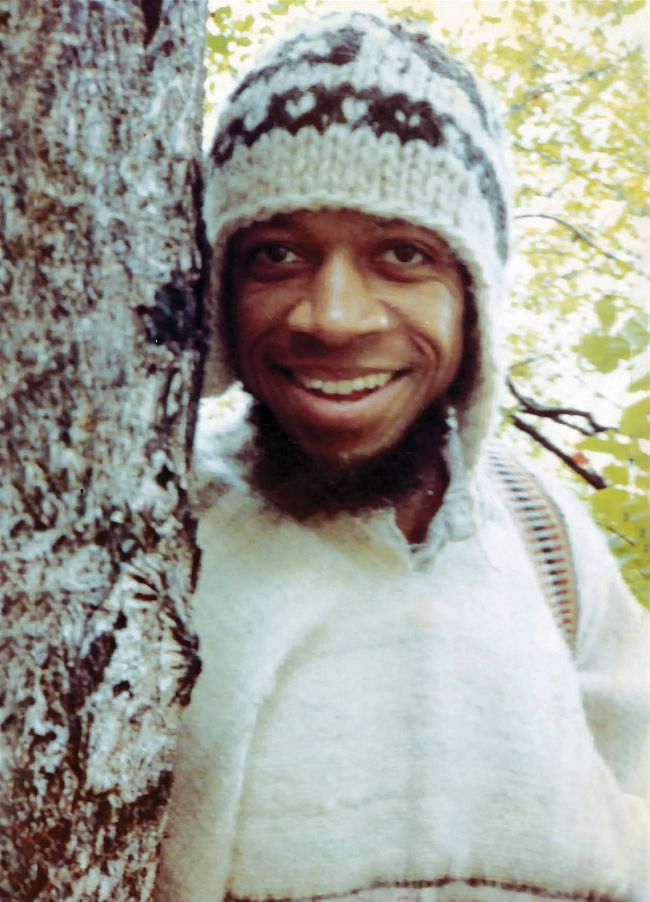
Hither and zither: inner-space man Laraaji, late ’70s
JANE JONES
THINK of a song, not any particular song, just the idea of a song. Say it’s the late 1970s when Laraaji was roaming the streets and parks of New York with his electrofitted autoharp. A song with its anticipated structure and its lyrical text is there to tell you about an experience. Laraaji’s music is the experience.
The life of Edward Larry Gordon, born in Philadelphia in 1943, appears to have been one long chain of serendipity. Raised in New Jersey, he sang in Baptist church choirs as a kid before studying piano at Howard University. A talent for performing, comedy and role play brought him to Harlem’s Apollo Theatre, where he acted as host in the mid-’60s, while also serenading legendary boho hangouts Café Wha?, the Bitter End and the Village Gate with his folkish songbook. He even scored a role as long as a goldfish recall in Robert Downey Sr’s cult ad-men madness movie Putney Swope in 1969. But this is all ancient prehistory.
A little more sand runs through the hourglass and we’re in Washington Square Park, circa 1975. Ed Gordon is by now entrenched up to his scapula in the cosmopolitan alternative lifestyle movement in which everything from yoga and meditation to pot, improvised music and barefoot dancing is involved. His guitar has been pawned and in its stead an autoharp purchased on impulse. Jenny Lynch is passing by in the park and likes what she hears emanating from the autoharp, which he has stripped of its chord bars and amplified with an electric pickup. He taps and strums the pentatonic-tuned wires with chopsticks, brushes and metal slides. Jenny is a luthier who just built a hammered dulcimer for folk musician Dorothy Carter. She writes down his number, recommends him to Carter, and before you know it he’s accompanying her and running workshops on ‘electronic autoharp experiments with tuning and phase shifters’ at the 1976 Boston Globe Jazzfest and Music Fair.