When legacy go low-cost
If there were a graveyard for airlines, it would be littered with the headstones of various ‘airlines within airlines’ that legacy carriers established over the years to fight off competition from low-cost start-ups. Lee Cross looks back at the multiple failures
The term low-cost carrier (LCC) can be traced back to the launch of interstate operations in California by Pacific Southwest Airlines (PSA) in 1949. Its success inspired several other LCC start-ups across the US, most notably Southwest Airlines, launched by Herb Kelleher in 1971. In turn, Kelleher inspired various other LCC start-ups, and by the 1990s, a new low-cost revolution had begun.
Previously, full-service carriers (FSCs) had reacted to LCCs by simply lowering their fares and pricing their competitors out of the market. But these newly emerging no-frills carriers on both sides of the pond were different, ushering in a new era of air travel. Despite an initial blasé attitude, before long, legacy carriers were forced to react as passengers were drawn to the lower fares of these new economical entrants.
Early entrants
One of the first legacy carriers to launch its own LCC was Continental Airlines, which announced Continental Lite in 1993. With a dedicated fleet of
McDonnell Douglas DC-9s and Boeing 737-300s and -500s, reconfigured in an all-economy layout, the airline expanded to serve 45 cities in 1994, mainly across the US East Coast. Despite growing to account for a third of its parent company’s total capacity, a year after its formation Continental Lite had failed to make a profit and underperforming routes were slashed. In April 1995, after announcing losses of $613m, its parent company announced the unit would be closed down in July.
The next FSC to launch an in-house
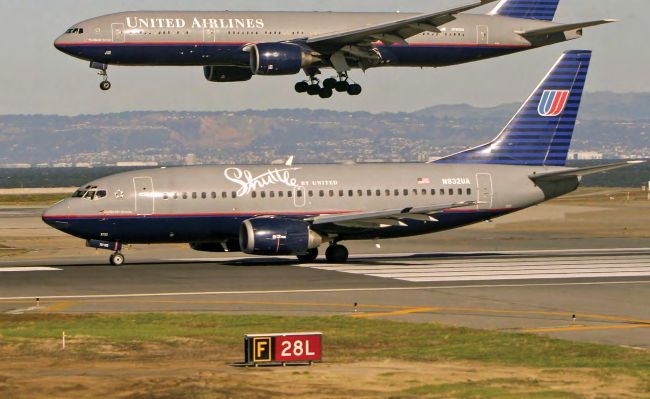
Shuttle by United was based in San Francisco and operated a fleet of Boeing 737-300s and -500s acquired from its parent
AVIATION IMAGE NETWORK/BAILEY
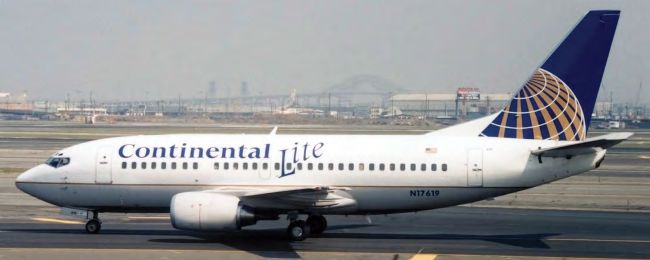
Continental Lite was one of the earliest low-cost airlines within an airline launched by a legacy carrier
AVIATION IMAGE NETWORK/
SIMON GREGORY
LCC was United Airlines. Faced with an aggressive assault on its operation in California by Southwest, a market it had previously dominated, the airline’s new CEO, Steven Wolf, went to the unions with a plan to reduce its costs where possible. Despite their pushbacks, an agreement was reached, and Shuttle by United was born. Launched on October 1, 1994, from its San Francisco hub, the airline initially boasted a strong performance. With a fleet of Boeing 737-300s and -500s transferred from its parent, at its peak the airline was flying 469 flights per day to 22 cities across the western US.