SUPERMARINE SPITFIRE
Excuse me while I kiss the sky
The Spitfire is revered for its engineering excellence and its role on the right side of history. ANDREW FRANKEL enjoys the ultimate flight of fancy
PHOTOGRAPHY LIAM YOUNG
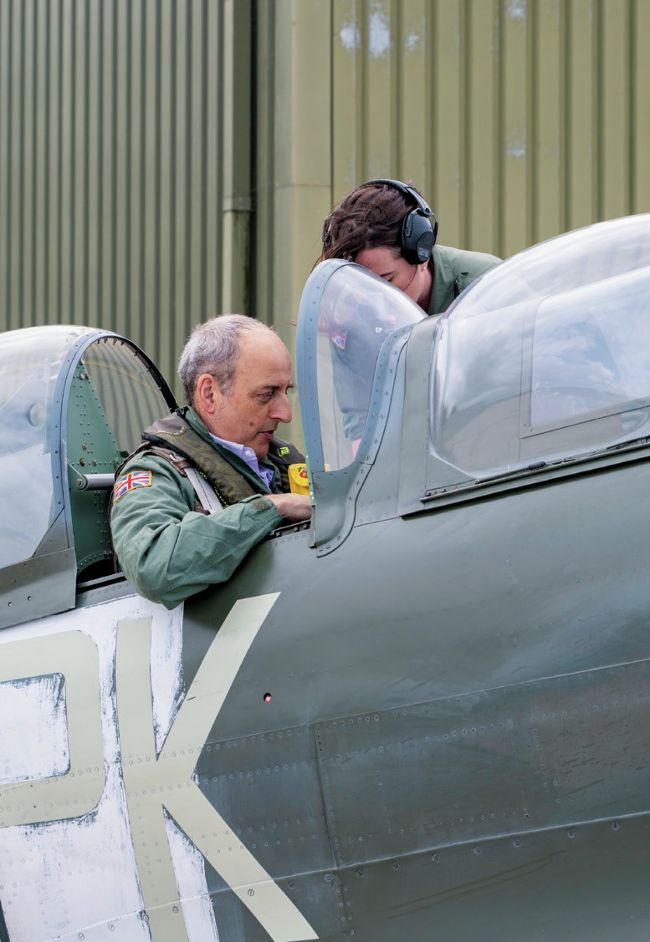
Frankel gets strapped in
A
cough A splutter. A jet of flame for good measure and the Merlin is prised from its slumbers and into rambunctious life. Many of you, perhaps even most, will have heard one of these engines, at Goodwood or an airshow. But unless you’re physically strapped into an aircraft boasting one, you can never claim to have felt one too. But I have. For I am in a Supermarine Spitfire, parked on the grass that forms the infield at Goodwood and, very shortly now, I shall be flying it.
We know the Goodwood aerodrome for the wonderful Revival and Members’ Meetings it hosts, but before any of that, it was RAF Westhampnett, a Spitfire base and, indeed, from where the double-amputee flying ace Douglas Bader departed for his final flight before spending the rest of the Second World War as a prisoner of war. Old aerial photos of the base show that what is today a race track was then the airfield’s perimeter road – what you drove around to get to where your kite was parked. In this case, it’s a Supermarine Spitfire MkIX, complete with 27-litre, twin-stage-supercharged, 48-valve, V12 Rolls-Royce Merlin 61 engine.
We all know the Merlin was named after the wizard of Arthurian legend, and in that regard, if no other, we are all wrong. It’s actually named after Europe’s smallest falcon. It was produced in a dizzying array of forms, including one used in tanks, from 1936 to 1950, in which time almost 150,000 were built, most famously for the Spitfire, Hawker Hurricane, de Havilland Mosquito and Avro Lancaster. Although a Rolls-Royce engine, it was built under licence by Packard in the US and by Ford in Manchester. Rolls-Royce facilities included factories in Derby, Glasgow and, of course, Crewe.