CLASSIC ALBUM
A WALK ACROSS THE ROOFTOPS
THE BLUE NILE
THEY ONLY MADE FOUR ALBUMS IN 20 YEARS, SO THE BLUE NILE’S EVERY RECORD IS PRECIOUS. BUT THE SCOTTISH TRIO’S DEBUT OFFERED AN AS YET UNSURPASSED STRAIN OF SOBER BUT STIRRING SYNTH-POP.
WYNDHAM WALLACE
“ Being able to listen to music, and being able to talk to each other through music, is like being able to walk on air,”
Paul Buchanan once told Graeme Thomson of Scotland’s The Herald, basking in the glow of his first Top 10 hit, albeit scored as guest vocalist on Texas’ Sleep two years after his own band had released what appears to have been their swansong, 2004’s High. “It’s like a miracle that we don’t really ever discuss. Why in the name of God can it reduce you to tears when one note goes ‘Ah’ and another note goes ‘Oh’ at the same time? Listening to melodies and going on these mini-journeys is so crucial, and it saddens me sometimes that music has just turned into a loss-leader in a supermarket. It’s like a miracle that has been turned into a marketing factor. I’m absolutely dumbfounded by it. Every record should be compared to silence – silence is perfect, what are you going to put on it?”
Melodies, mini-journeys, miracles and silence… These are the stuff of 1984’s A Walk Across The Rooftops, the debut album by The Blue Nile, whom Buchanan fronted over the course of four LPs. A work of delicate grace and understated yet transparent emotions, it’s hardly one of the 80s’ most attention-seeking records, yet – alongside its follow-up, 1989’s Hats – it remains one of that decade’s most cherished, casting a twilit shadow even now. Beloved of Peter Gabriel, who’s said to have ordered boxes of it from their label for friends, it was also deemed “the best debut album of the last five years” by renowned U2 producer Steve Lillywhite. Not bad, given its initial pressing was just 2,000 copies on a label run by a small Scottish hi-fi company.
That A Walk Across The Rooftops began its commercial life in humble fashion is fitting, because it’s obsessed with minutiae. Peppered with lyrical particulars – the title track’s “The jangle of Saint Stephen’s bells/ The telephones that ring all night”, Tinseltown In The Rain’s “There’s a red car in the fountain”, Easter Parade’s “A city perfect in every detail” – its peaceful synth-pop is suffused with a tenebrous, melancholic beauty matched by spacious arrangements and unrecognisable yet strangely familiar noises. “We were very intrigued,” Buchanan once told the BBC’s Johnnie Walker, “by what we felt a sound could tell you visually.”
It took Buchanan and his bandmates, Robert Bell and Paul Joseph ‘PJ’ Moore, some time to find their distinctive voice. First united at Glasgow University in the late 70s, they’d begun playing together in a series of unsuccessful line-ups, their names largely consigned to history. “I met Robert through other people who were trying to get a band off the ground,”
“EVERY RECORD SHOULD BE COMPARED TO SILENCE – SILENCE IS PERFECT, WHAT ARE YOU GOING TO PUT ON IT?”
PAUL BUCHANAN
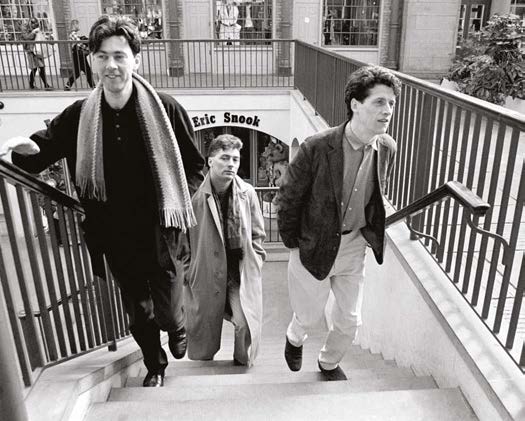
The Blue Nile in Covent Garden, London, March 1984
© Andre Csillag
Buchanan told Walker. “I wasn’t really thinking that. At that point I was thinking, I dunno, maybe I could go play in a bar with an acoustic guitar as a student and make some money. Anyway, I didn’t do that. Instead… we