MINERALS AND METALS OF THE BIBLE
Brimstone, Salt, Copper, and Clay
Story and Photos by Steve Voynick
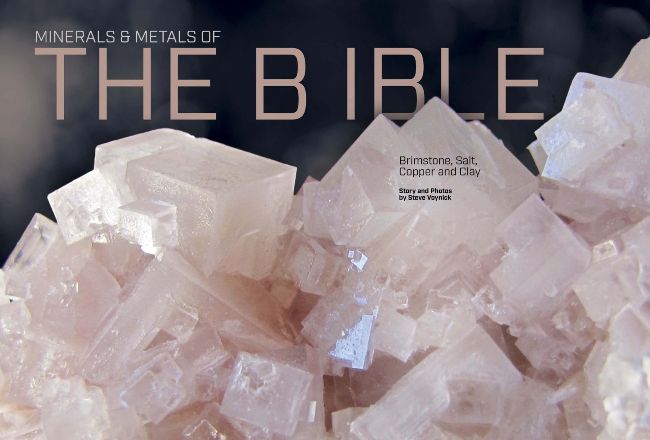
Rock salt from Jebel Usdum near the Dead Sea, a deposit that was first mined about 1000 B.C.
The Bible references minerals and metals more than 1,700 times, using such familiar phrases as “fire and brimstone,” “pieces of silver,” “copper from the rock,” “salt of the Earth,” and “jars of clay.” It is interesting to consider these minerals and metals not in their scriptural contexts, but from the perspectives of history, geology, and biblical archaeology.
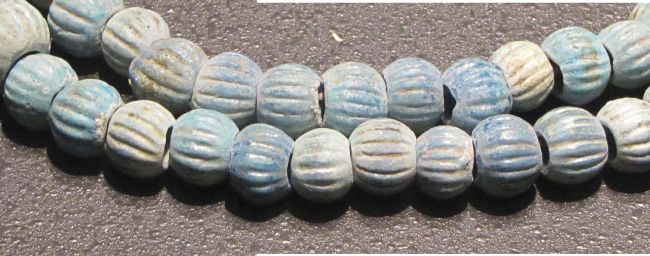
Glass was a valuable material in biblical times and even served as a semiprecious gemstone.
Biblical archaeologists study ancient cultural sites and artifacts to gain insight into the Bible’s Old and New Testaments. Combining archaeology with scriptural interpretation provides a clearer understanding of life as it was and the events that occurred during the biblical period, which extends more than three millennia from 3300 B.C. to the first century A.D.
Biblical archaeologists understandably focus on the Holy Land, the region between the Jordan Rift Valley and the Mediterranean Sea that now includes the State of Israel and the Palestinian territories, along with parts of Lebanon, Syria, and Jordan. Their interest also extends to adjacent areas of biblical relevance from Egypt and the Arabian Peninsula in the south to Turkey in the north and Iraq in the east.
Archaeologists divide biblical history into three general periods based on the dominant material used in tools and weapons: the Stone Age (Neolithic), the Bronze Age, and the Iron Age. The late Stone Age includes the Chalcolithic Period, a transitional subperiod in which stone and copper were used simultaneously. These cultural periods occurred at different times in different regions. In the Holy Land, the Bronze Age began about 3300 B.C.; the Iron Age started about 1200 B.C.
The Jordan Riff Valley, the northern limit of the 3,700-mile-long East African Riff System, the Earth’s largest land riff, dominates the Holy Land’s topography. This riff system began forming 35 million years ago with a westward separation of the African tectonic plate from the Asian plate and fractured the crust into long, parallel faults. The crust between the faults subsided, sometimes thousand of feet, to create long, linear sequence of narrow riff valleys. The East African Riff System, including the Jordan Riff Valley, is still widening today.
The Jordan Rift Valley extends from Lebanon south for 300 miles to the Gulf of Aqaba. Within it are the Jordan River, the Sea of Galilee, the Dead Sea (the lowest land point on Earth at 1,237 feet below sea level), and the desolate Wadi Araba, all features of biblical significance.
The Bible mentions six metals: gold, silver, lead, tin, copper, and iron. Although not mined in the Holy Land, gold and silver played major roles in biblical history. The Bible mentions gold more than 400 times, and silver nearly 300 times.