How to draw the horse
In the first of two articles equestrian artist Ruth Buchanan shares her 10 key techniques for making a successful drawing of the horse
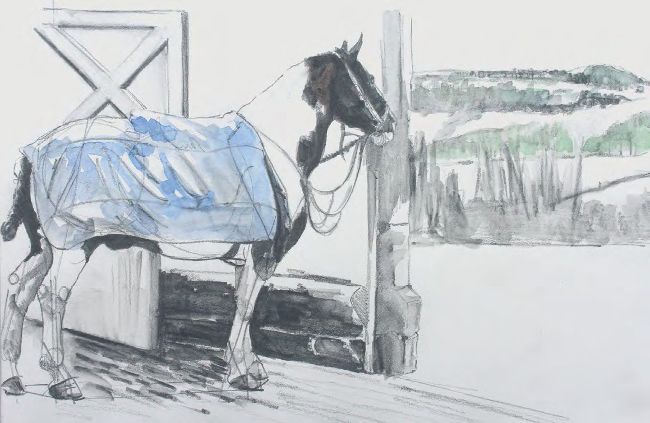
Working drawing in graphite and watercolour of cob, Jester
Ruth Buchanan worked as an illustrator before becoming a full-time artist. She exhibits at international equestrian events as well as in galleries, and her work features in private and corporate collections in the UK, Europe and the USA. In 2017 she won the Two Rivers Sketchbook Award and The Association of Animal Artists’ Inaugural Chairman Award, which is judged on a body of work. Ruth lives and works in Yorkshire.
Drawing should be enjoyable. Sketching in particular should be fast, immediate and about catching a moment that can be developed later, or simply for the joy of capturing a movement and attitude.
The techniques outlined in this article are based on my experience in life drawing and they can be used for any subject. The subjects I consider the most are people and horses and, although horses are a challenging subject, it is possible to learn by looking, breaking down what you see into shapes, angles and tones and the five Ps: patience, persistence, practice, practice and practice.
Most people think of drawing a horse as a linear outline, starting at the ears and continuing through the full silhouette. It is possible to draw like this but I think it is the most difficult approach, as you need an inherent understanding of form and proportion. In drawing workshops I ask people to work through a series of exercises based on ten approaches to drawing.