TEN COSMIC MYSTERIES
THE LARGE HADRON COLLIDER COULD SOLVE
What problems could the world’s largest and most powerful particle accelerator unlock?
Reported by Chelsea Gohd
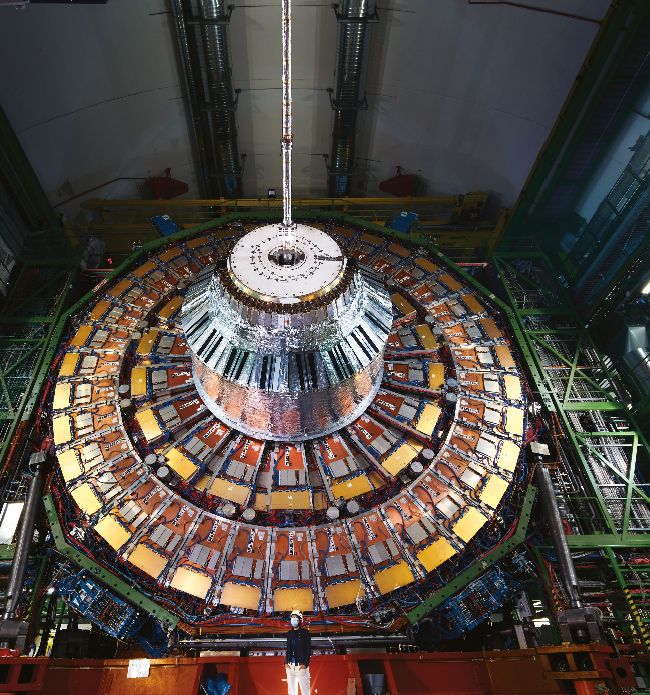
© CERN; Getty
The Large Hadron Collider (LHC) at CERN (the European Organization for Nuclear Research) near Geneva, Switzerland, was just switched back on for the third time after a three-year hiatus planned to implement upgrades. In the 14 years since it was first turned on, the particle accelerator has explored some of the biggest mysteries in the universe, colliding countless particles at near the speed of light in a tunnel 100 metres (328 feet) underground. One of the most amazing things about the LHC is that scientists don’t know exactly what might happen when they smash protons together at nearly the speed of light. Despite its years of driving groundbreaking science, at the end of Run 2 in 2018, scientists estimated that the LHC had only delivered about three per cent of the data expected in its lifetime. with Run 3 about to begin, it’s just getting started.

The Higgs boson takes its name after theoretical physicist Peter Higgs
THE HIGGS BOSON
1 Probably the most famous discovery to come out of the LHC to date, the Higgs boson is an elementary particle, the existence of which was confirmed in 2012 at the LHC. But there is still a lot to be learned from studying the strange particle.
The particle is associated with what is called the Higgs field, which gives mass to other elementary or fundamental particles like electrons and the quarks that make up protons. The particle even gets its own mass from interactions with the Higgs field. But not all fundamental particles have mass: the photon, or light particle, has no mass, for example.
There remain many mysteries about the Higgs boson. With future experimentation at the LHC, particle physicists could paint a more complete picture of this strange particle. LHC scientists have already observed the Higgs particle doing strange things ever since they spotted it, offering additional mysteries to solve.
FINDING HINTS OF HIGGS
Was mass mediated by the Higgs boson? That’s what the LHC tried to find out by using electromagnetic fields to whip beams of protons around and around to nearly the speed of light. When these protons collide, energy is released and new particles are made, which can provide evidence for the Higgs boson.
MASS AND MATTER
Matter particles, such as those that constitute atoms, contain mass. These particles come in two categories: fermions include quarks and leptons, while forces such as electromagnetism are carried by bosons.
HIGGS: WHY MATTER HAS MASS
Particles may be more massive than one another because they feel the Higgs field differently. It’s because of the Higgs boson that matter has mass.
Meeting the field
The Higgs field occurs everywhere throughout the universe and gives matter particles – as well as Higgs bosons – their mass.
Enter ordinary matter
When matter moves through the Higgs field, it becomes excited and forms Higgs bosons. These cluster around a particle to give it mass.
High-speed photons
Some particles move through space without interacting with the Higgs field. This means they don’t gain any mass from Higgs bosons.