FAVOURITE NEW CARS REVIEW
THE STAR CARS OF THE YEAR
No ‘chosen by committee’ compromises here, just simple personal prejudice as Autocar testers choose their favourite new cars of 2023
FISKER OCEAN
Slowly, it’s becoming acceptable to have mixed feelings about electric cars. Personally, I’m still ambivalent. But that seems increasingly to be a reasonable place to be now that the discourse about them is more nuanced – and you no longer seem to need to be either ‘on the team’ or a zealous EV sceptic just to have a voice.
The Fisker Ocean is a very good, depolarising influence on the EV scene. Having driven one in Austria in the summer, I’m a little concerned that, as I write, I’ve yet to see any right-hand-drive ones in the UK, but Fisker is learning just about everything as it goes so it’s probably due a bit of slack on that score.
There’s a lot I like about this car. I guess there are certain parallels between Fisker and Tesla for the tendency of either brand towards cult status, but the Ocean, at least, is a pretty ordinary family car that can be bought for a fairly ordinary price and has the space and versatility simply to be used – but used widely.
That’s because the Ocean offers transformative electric range for a price you can genuinely contemplate spending. Above all else, its creators understood that buyers still need reassurance on that score. So a mid-range Ocean Ultra is a little over £50,000, but has a lab-tested electric range of 429 miles – and real-world autonomy that should be between 350 and 400 miles in the UK, on the basis of my test driving and depending a little on usage. And here’s me, feeling as if I’ve written about another new electric car every other week this year, each costing something similar to the Ocean, but each only going somewhere between 200 and 275 miles on a charge.
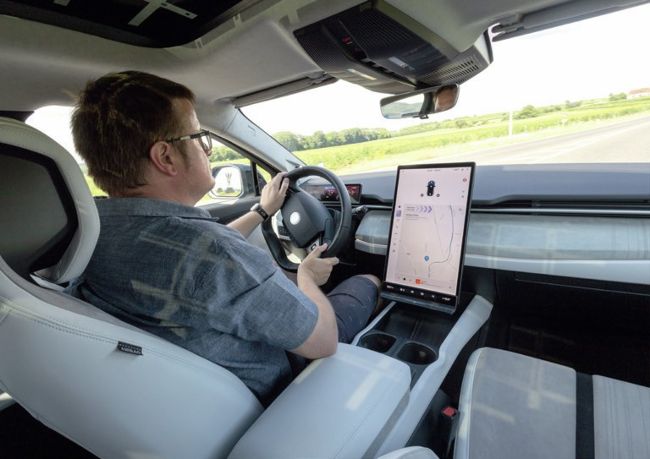
Ocean is the right kind of EV at the right time
There’s no genius to how that range has been delivered. Fisker has just gone for the biggest drive battery it can afford and, as a result, it’s made an EV that’s fairly heavy and that, while very comfy, doesn’t quite handle like a Polestar 2.
But it’s only prioritising. It’s observed the prospect of a ceiling for the market penetration of EVs – recognised that for people who, for whatever reason, can’t manage to charge at home, EVs look like a rather elitist and exclusive solution.
So it’s come up with a family car you could genuinely charge once or twice weekly, while out and about, instead – even if you’re a higher-mileage driver. One with a fresh face and some novelty features, sure, but, underneath the daft ‘taco tray’ and the cinemaaspect rotating infotainment screen, the deeply sensible, practical soul of the kind of EV that we’ve been waiting a long time for.
MATT SAUNDERS
PORSCHE 911 SPORT CLASSIC
Porsche is currently hooked on the hard stuff: the rare-groove special editions every manufacturer of note seems to be purveying as though their existence depended on it. (Maybe it does?) It’s obvious why. These creations delight the engineering teams, but so too do they have the beancounters positively frothing at the mouth, such is the willingness to swallow outrageous prices. It’s easy to see these projects as cynical.
And then you meet the cars first hand. The 911 Dakar? Silly car, silly price, but truly, superbly fine company in the real world and an instant classic. The new 911 S/T? Hugely contrived, despicably expensive, but probably the most intoxicating yet usable supercar Porsche has ever made. Sublime.
Which brings us to the 911 Sport Classic, which arguably started all this nonsense in the ‘997’ era, when it embraced a style-over-substance approach with an entirely pointless duck-tail, houndstooth innards and almost no mechanical tickles. Asking price: £140k. Or, in 2009, £10k more than a 911 GT2!