BBC NLP
by Fiona Nicholson, Science Writer
Neuro-linguistic programming (NLP) is a pseudoscientific approach to communication, personal development, and psychotherapy created by Richard Bandler and John Grinder in California, United States, in the 1970s. NLP’s creators claim there is a connection between neurological processes (neuro-), language (linguistic) and behavioural patterns learned through experience (programming), and that these can be changed to achieve specific goals in life.

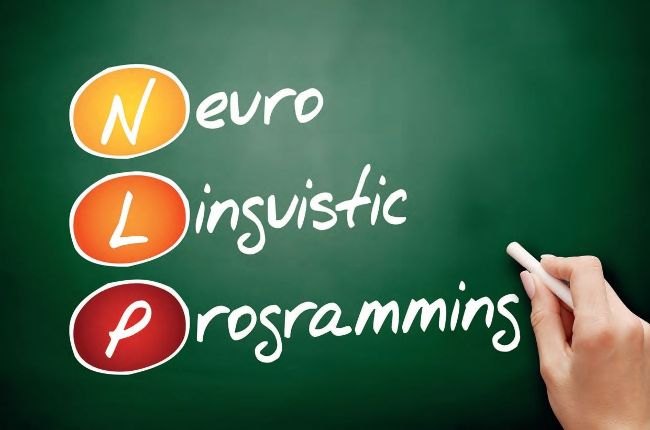
Neuro -linguistic programming (NLP), which came to prominence mainly in the fields of entertainment and commercial life coaching, has been dismissed often as a pseudo-science with no validity in the world of behaviour change. It is seen as a hotchpotch of ideas derived from various schools of counselling and psychotherapy. Yet among the contributors to NLP have been well known and respected figures such as Noam Chomsky, linguist, founder of the school of Cognitive Psychology and political activist. Chomsky developed one of the most important theories in our current understanding of how learning takes place, and he built this in part on the theory of NLP. As a behaviour change therapy, NLP aims to help people who are stuck in a certain pattern of thoughts and feelings that is not helpful in today’s world, by giving them the skills to reframe their understanding, beliefs and opinions in a more helpful direction. However, according to Adriana James, author of Values and the evolution of consciousness (2014), NLP can be used for a different kind of manipulation, one without integrity, with the goal of exerting control over others.
The basis of NLP theory is that our sensory and emotional experiences are held within deep brain structures, although these are expressed in our thoughts, beliefs and opinions which are brain surface structures. It is recognised today that emotion arises in the ancient brain structures which are common to all mammals and many non-mammals also. Emotions are an evolutionary adaptation which help the individual to survive, and this understanding has revealed that the inner life, emotions and sentience of other animals is remarkably similar to our own. As the emotions and sensory experiences come from the deeper brain structures to the cognitive processors of the surface brain, NLP proposes that these experiences undergo filtering transformations which include deletion, generalisation and distortion. Similarly, surface structures such as language transform the deeper structures involved in producing subjective experience, opinions and feelings which have previously been imprinted in the deep brain. All behaviour, conscious or non-conscious arises from the unique set of strategies which each of us possesses, imprinted by past experiences and consequences. Thus, by manipulating language and linguistic structures, we can achieve the deletion, distortion and generalisation of previously held experiences, emotions and beliefs in a re-imprinting process which alters pre-existing beliefs and opinions. In conjunction with other techniques, including gaslighting, NLP can be part of a strong re-education process, or brainwashing.
Lisez l'article complet et bien d'autres dans ce numéro de
iScot Magazine
Options d'achat ci-dessous
Si le problème vous appartient,
Connexion
pour lire l'article complet maintenant.
Numéro unique numérique
Issue 67
Ce numéro et d'autres anciens numéros ne sont pas inclus dans une nouvelle version de l'article
abonnement. Les abonnements comprennent le dernier numéro régulier et les nouveaux numéros publiés pendant votre abonnement.
iScot Magazine
Abonnement numérique annuel
€35,99
facturé annuellement
Abonnement numérique annuel
€47,99
facturé annuellement
Abonnement numérique mensuel
€4,99
facturé mensuellement