Vous consultez actuellement le France version du site.
Voulez-vous passer à votre site local ?
13 TEMPS DE LECTURE MIN

Software management

Installing and managing software

LINUX BASICS

From app stores to adding package archives and wrestling with sandbox formats, Nick Peers runs through the software options.

Part Three! Don’t miss next issue, subscribe on page 16!

OUR EXPERT

Nick Peers has been left scratching his head as he runs through all the different methods of installing software.

Thankfully, that leaves his other hand free to keep count.

When it comes to installing software on your new Linux machine, you’re spoiled for choice. W And we don’t just mean by the sheer variety of applications, games and tools on offer. In many cases, you have a choice of how you want to install those programs, too. Prepare to be bedazzled (and confuddled) by such terms as ‘Apt’, ‘DEB packages’, ‘Snap’, ‘Flatpak’ and ‘AppImages’, to name but some of the many installation methods available to you. Each of these methods works in a different way, as you’ll see later. But let’s start with the most obvious source for new software: your distro’s package manager. This provides you with an easy way to find and install programs without having to use the terminal, even though last month’s tutorial hopefully revealed that it’s not as scary or complex as you might have thought.

The package manager varies from distro to distro. Ubuntu 24.04 LTS users will find App Center prominently displayed on the Dash, while Linux Mint users can open Software Manager directly from its Start menu shortcut. Once open, you’ll see the tool provides a reasonably intuitive interface for you to use. The annotation (opposite page) reveals how this works in Ubuntu, but other distros – including Software Mint’s Software Manager works in a similar way to Ubuntu’s App Center, but Mint chooses to work with container-based apps from Flatpak rather than Snap.
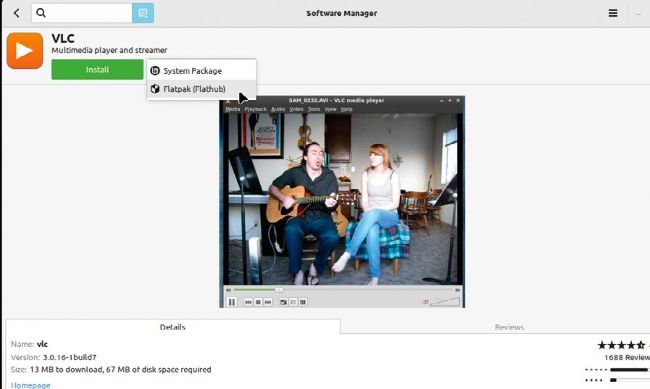
Manager – work in a similar way. You basically browse the applications on offer or search for a specific package, review the versions offered, select one and click Install. The application is installed, and shortcuts are placed in the appropriate places for easy access.

Beneath the hood

While you might think that package managers source their software from the same place, sadly this isn’t true. In the case of Linux Mint, its Software Manager gives you a choice between System Package and Flatpak. Ubuntu’s App Center is now focused on delivering apps via Snap, although it does support – in a roundabout fashion – older ‘system packages’ like those offered by Mint. So, what’s the difference between these different sources, and which one should you choose? Let’s start with basic system packages. These come from the most traditional source of software for all Debian-based distros like Ubuntu and Mint: special archives known as repositories, or repos. They can be installed through the terminal using the Apt package tool, which we covered in last month’s Linux Basics tutorial. Traditionally, package managers such as App Center were designed to provide more user-friendly access to these packages through a neat graphical front-end.

Débloquez cet article et bien plus encore avec
Vous pouvez en profiter :
Découvrez l'intégralité de cette édition
Accès instantané à plus de 600 titres
Des milliers d'anciens numéros
Pas de contrat ni d'engagement
Essayer pour €1.09
S'ABONNER
30 jours d'accès, puis seulement €11,99 / mois. Résiliation à tout moment. Nouveaux abonnés uniquement.


En savoir plus
Pocketmags Plus
Pocketmags Plus

Cet article est tiré de...


View Issues
Linux Format
August 2024
VOIR EN MAGASIN

Autres articles dans ce numéro


LINUX FORMAT
LINUX FORMAT
The #1 open source mag Future Publishing Limited,
WELCOME
Rescue and repair
We often like to have a little giggle
LINUX FORMAT
MEET THE TEAM
REGULARS AT A GLANCE
Distros start to ban AI code
Generative AI continues to court controversy as Gentoo and NetBSD heavily restrict its implementation.
Qualcomm on upstreaming to Linux
Patchsets for the Snapdragon X Elite SoC aim at Linux compatibility.
APT 3.0 is coming
New APT solver comes with a number of changes.
A LIBRE SUMMER
Italo Vignoli is one of the founders of LibreOffice and the Document Foundation.
THE LONG HAUL
David Stokes is a technology evangelist at Percona.
Framework optimises screen
Invisible pixels promised.
KeePassXC kerfuffle
Upcoming Debian Trixie implementation of KeePassXC won’t offer optional features like browser integration.
Neofetch is dead
Creator of utility archives repo to take up farming.
What’s behind the free software sofa?
LINUX LITE 7.0 Linux Lite has a tweaked
FEEL THE G-FORCE
Daniel Morin is a senior software developer at
Kernel Watch
Jon Masters summarises the latest happenings in the Linux kernel, so that you don’t have to.
Answers
Neil Bothwick swallowed a Got a burning question
Mailserver
Quantum Leap Seeing as Linus Torvalds wrote programs
HotPicks
THE BEST NEW OPEN SOURCE SOFTWARE ON THE PLANET
REVIEWS
Ryzen 7 5700X3D
Paul Alcorn is feeling more powerful than ever with AMD inside!
LibreELEC 12.0
Nate Drake is impressed with the freedom that the latest version of LibreELEC (code name Omega) offers to cosy up to Kodi.
AlmaLinux 9.4
Alma is the Spanish word for soul. Nate Drake certainly feels his has been uplifted through this spiritual successor to CentOS.
SparkyLinux 2024.05
Nate Drake blinks and almost misses this zippy Debian-based distro, so light on resources it runs perfectly on ancient hardware.
Garuda Linux 240428
Nate Drake seldom applies the words ‘luxurious’ or ‘sumptuous’ to an OS, but in Garuda’s case, he makes an exception.
Nvidia GeForce Now for Steam Deck
Management is wondering where Dave Meikleham and Alex Wawro are. Perhaps those noises from the server dungeon aren’t those of hard work…
ROUNDUP
ROUNDUP
Hyper Cool Retro Term Yakuake Terminator Terminology
Save your old PC
REPAIR IT WITH LINUX
Don’t consign your old machines to the scrap heap just yet – Jonni Bidwell reckons they can still be put to work.
Time and tide
Linux can run on various machines that are plenty old, but first we really ought to manage your expectations.
Hardware refresh
Fifty British pounds (or local equivalent) and half an hour on an auction site might give your PC the shot in the arm it craves.
Introducing L MDE
We investigate the easy-to-use but powerful Linux Mint Debian Edition – like regular Mint, but with less Ubuntu, more Debian.
Vintage PC options
We look at some alternative web browsers, and summarise the ultra-lightweight distro scene for particularly old systems.
Pi USER
$40 million Raspberry Pi IPO set for June
London Stock Exchange to be hit by Pi.
Easier coding
With management tools
Get together!
Clubs are back, baby
TAKING A HAT FOR A DRIVE
The Raspberry Pi M.2 HAT+ has finally been
Ubuntu 24.04 LTS Pi
Les Pounder has been using Ubuntu since 2005, which makes him feel incredibly old. Can Ubuntu 24.04 on the Pi 5 make him young again?
QIDI Tech Q1 Pro
Getting hot under the collar, Denise Bertacchi likes this heated model.
PYTHON
Build your own fortune teller
All of your Pis are under your control
No one would say Les Pounder has gone power mad, but he’s cackling like a Bond villain now he can control all the Pis.
IN DEPTH
Virtual this, that & the other
Matt Holder delves deeper into the kernel to discover virtualisation, containerisation and virtual filesystems.
TUTORIALS
Fancy file management
While CLI purists scoff at TUI tools, Shashank Sharma has no hesitation working with wonderfully crafted utilities that do their job well.
Install and control Flatpak software
Get installing tools with the distro-agnostic packaging system that offers all sorts of advantages. Michael Reed has come packing his hex key set.
Create a Fyne journaling app
Dressed in his programming finery, Andrew Williams shows how you can quickly build a graphical app for your computer using Fyne and Go.
Reliving the birth of the terminal
It looked like a PC but, although it wasn’t user-programmable, the display terminal had a vital role in the days of minicomputers, says Mike Bedford.
Create old-school pixel art images
Still stuck with the ancient GIMP 2, Neil Mohr decides to go even more retro and explore how you can create classic pixel art with it.
ADMINISTERIA
Use some admin-fu to master snapshots
Most users don’t much care about the underlying disk management system LVM, but Stuart Burns reveals one of its most useful features.
Root & branch
Databases, observability, open core and trashed PCs get a mention as Linux Format talks to Percona founder Peter Zaitsev.
CODING ACADEMY
Create a play-by-mail user interface
David Bolton looks further into designing play-by-mail-type games, with insights about the user interface and core game features.
Screens of fractals and complex numbers
Blowing our minds and eyes with his psychedelic demos, it looks like Ferenc Deák has a rising medical bill to pay…
Chat
X
Support Pocketmags