HOW FLYING REPTILES EVOLVED
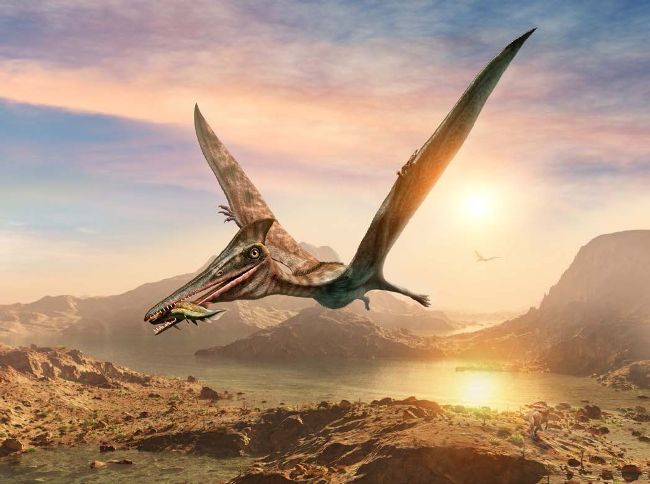
Artwork courtesy Warpaint/
www.shutterstock.com Pterosaurs were the earliest vertebrates to develop the ability to fly, dominating the skies for 150 million years before they died out along with the dinosaurs some 66 million years ago. However, key details of their evolutionary origin and how they gained their ability to fly have remained a mystery; one that palaeontologists have been trying to crack for the past 200 years.
In order to learn more about their evolution and fill in a few gaps in the fossil record, their closest relatives had to be identified. Now, with the help of newly discovered skulls and skeletons that have been unearthed in North America, Brazil, Argentina and Madagascar over recent years, Virginia Tech researchers Sterling Nesbitt and Michelle Stocker from the Department of Geosciences in the College of Science have demonstrated that a group of ‘dinosaur precursors’ called lagerpetids are in fact the closest relatives of pterosaurs.
A major breakthrough
“The question as to where pterosaurs came from is one of the most significant in reptile evolution; we think we now have an answer,” says Nesbitt, who is an associate professor of geosciences and an affiliated faculty member of the Fralin Life Sciences Institute and the Global Change Center.
Lisez l'article complet et bien d'autres dans ce numéro de
Practical Reptile Keeping
Options d'achat ci-dessous
Si le problème vous appartient,
Connexion
pour lire l'article complet maintenant.
Numéro unique numérique
January 2021
Ce numéro et d'autres anciens numéros ne sont pas inclus dans une nouvelle version de l'article
abonnement. Les abonnements comprennent le dernier numéro régulier et les nouveaux numéros publiés pendant votre abonnement.
Practical Reptile Keeping
Abonnement numérique annuel
€39,99
facturé annuellement
Abonnement numérique de 6 mois
€21,99
facturé deux fois par an