Innovative And Uncategorisable
Born in the titular Kent city in the late 60s, the Canterbury scene spawned some of prog’s most creative and quirky acts. From The Wilde Flowers and Soft Machine to Caravan and Gong, each had a distinctive sound and, in many cases, image that captured the hearts and minds of their followers. But the scene’s impact didn’t end in the 70s. Phil Howitt, Facelift editor and Hugh Hopper’s biographer, explores the new breed of progressive acts inspired by it, both consciously and unwittingly, and unearths the secrets of the ‘Canterbury chord’.
Words: Phil Howitt
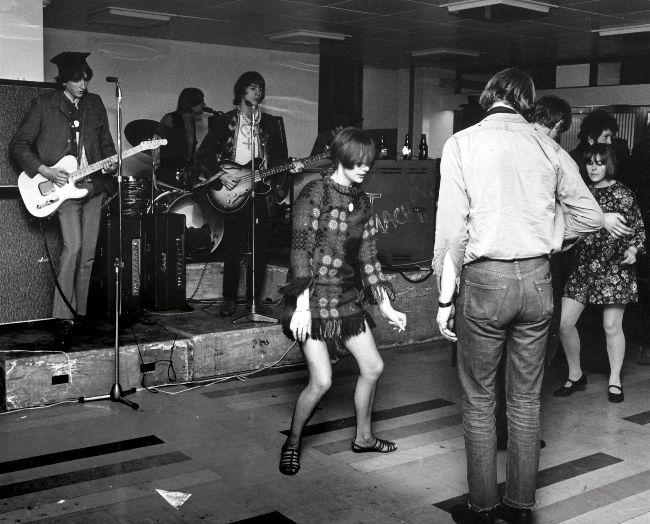
Soft Machine provide some sonic respite to students who had been taking part in a protest at the London School Of Economics in March 1967.
Image: Express/Express/Getty Images
“When I’m making music I’m not thinking, ‘I’ve got to be a part of a scene.’ I don’t want to be boxed in or make the same album forever. Those elements are always going to be in Zopp.”
Ryan Stevenson (Zopp)
Back in the mists of 2015, in Prog 55, Sid Smith explored the existence of the semi-mythical beast that is the Canterbury scene. The consensus is that it comprises a loose connection of musicians and music emanating from a band called The Wilde Flowers who gigged between 1965 and 1968 and whose members went on not just to form the classic Caravan line-up, but also an earlier nucleus of Soft Machine, alongside Mike Ratledge and Australian beatnik Daevid Allen (later of Gong).
The Canterbury scene would also come to encompass Gong, Robert Wyatt’s Matching Mole, Kevin Ayers And The Whole World, Hatfield And The North and National Health, while taking in members en route from Egg and Delivery. A number of rock family trees, initiated by Pete Frame’s The Incestuous Tales Of Canterbury Heads in a 1973 edition of Zig Zag, have expanded the definition to capture any loosely affiliated bands, most remarkably one penned by Japanese musician Osamu Sakamoto of Japanese ‘Canterbury’ band Soft Weed Factor, which incorporates Henry Cow, Camel, Curved Air, Roxy Music and the Police! As one might expect, debate continues to rage on social media as to how far to push the concept.
There’s also a parallel argument as to what constitutes the Canterbury scene musically – the Canterbury sound, if you like. A recent fan-based survey conducted for Canterbury Christ Church University sought views from fans on what they thought it might be. There were almost as many different ideas as respondents, but a number of common denominators emerged: one was that it encompassed the city itself, its religious traditions and pastoral setting. Another was that it was the jazzy straddling of other genres, or as one fan put it: “You can get heavy, dark, psychedelic, spacey, zany, cosmic, hymn-esque, groovy, the absurd, the catchy and the comforting. What other subgenre manages to incorporate all that?” The scene’s musicians were more likely to play keyboards and wind instruments than guitar, with added effects such as fuzz bass. Unique English voices (including Wyatt, Ayers and Richard Sinclair) are associated with the scene, augmented by lyrics that are often daft (Gong), saucy (Caravan) or throwaway (Hatfield And The North). Compositionally the music is complex but not flashy, and often contradictory in mood: intricate yet catchy; light yet complex; mellow then intense, or as one fan put it: “Peering into hidden corners.” Its musicians tended to be open-minded, and despite apparent virtuosity, often self-taught.