MEDITATE ON THIS, ZEN...
TOO MUCH MONKEY BUSINESS
A spiritually exhausted John Martin reports on the sacred pilgrimage he just took through 52 magical episodes of Monkey…
“In the worlds before Monkey, primal chaos reigned.Heaven sought order,but the phoenix can fly only when its feathers are grown.The four worlds formed again and yet again,as endless aeons wheeled and passed.Time and the pure essences of Heaven,the moisture of the Earth, the powers of the Sun and the Moon all worked upon a certain rock, old as Creation,and it became magically fertile. That first egg was named ‘Thought’.Tathagata Buddha, the Father Buddha, said,‘With our thoughts, we make the world.’Elemental forces caused the egg to hatch.From it then came a stone monkey. The nature of Monkey was irrepressible…Monkeeeeeey!!! ”
Still following this? And that’s just the introduction to the first episode.
If Tathagata Buddha was right and thoughts really do make the world, I’ll have a pint of whatever Nippon TV executive Tsuneo Hayakawa was on when he dreamed up the unadulterated TV Surrealism of Monkey (Japanese broadcast title Saiyûki/Account of the Journey to the West).
Of course the story wasn’t an original Hayakawa brainwave, rather a (pretty loose) adaptation of a 16th Century Chinese epic attributed to one Wu Cheng’en and detailing a young monk’s quest to retrieve an enlightening sutra (scripture) from Thunderclap Temple in India, with the aid of a colourful collection of spirit assistants.
Amid much shape shifting, identity swapping and gender bending, supported by regular pop-up interventions from assorted gods and Buddhas, they endure all manner of adversity and regular run-ins with bandits, demons and seductive sprites who are intent on foiling the delivery of that sutra and prolonging the suffering of all sentient beings, until it dawns on our pilgrims that in the pursuit of Enlightenment, the journey itself is the destination (a philosophical profundity which would ultimately come in very handy for the program makers, as we shall see).
The first series of Monkey was made to commemorate NTV’s 25th anniversary. Broadcast domestically between October 1978 and April 1979, in the 8pm Sunday slot, competing with NHK’s prestigious “Taiga” (historical drama) offering, it scored gratifyingly well considering its Y100 million budget (establishing shots were filmed in Northwest China and Inner Mongolia, though the balance of what you see took place on and around Tokyo sound stages).
NTV had already chalked up a major domestic hit during 1973-74 with the “bandits vs corrupt government” saga Suikoden, based on another (this time 14th Century) Chinese classic which Chairman Mao once cited as a major inspiration for his years of guerrilla struggle. That one was dubbed into English (with new dialogue courtesy of David Weir) and shown on the BBC as The Water Margin between 1976 and 1978, to such a positive response that Weir was soon called upon to do a similar job (his new dialogue ADR directed by Michael Bakewell) on Monkey, broadcast by the Beeb from 1979 onwards.
LOST IN TRANSLATION
Several years after Bruce Lee’s untimely death, UK audiences were still pretty receptive to anything with a suggestion of “Chop Socky” about it, though Monkey’s frequent combat scenes (played out to Godiego’s infectious prog/disco incidental music) were balletically staged, often verging on slapstick. Add elements of magic and fantasy, cool costumes, seriously cheesy special effects and endearing knockabout ensemble playing by its principals and what you get is perfect, fondly remembered family viewing; educational stuff too, laden with such sagacious Buddhist insights as “Even a starving camel is still bigger than a horse,” or “The eunuch should not take pride in his chastity.”
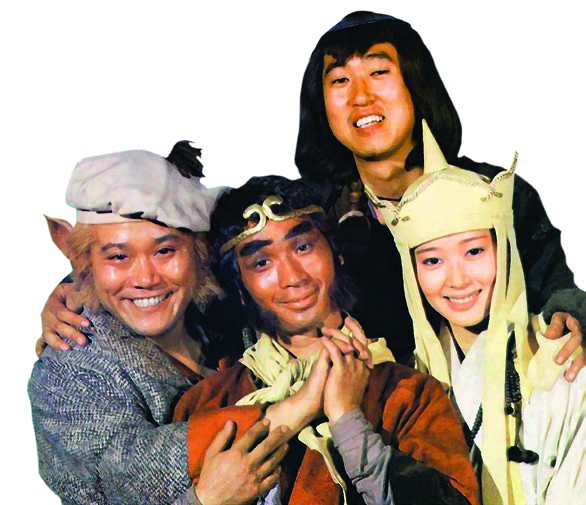
Image on right l-r:Shirô Kishibe, Toshiyuki Nishida,Masaaki Sakai and Masako Natsume in Saiyûki, aka Monkey (1978); opposite the same actors without Masaaki Sakai
Monkey Episode Guide
Episodes marked with a (**) are the ones that the BBC declined to broadcast in 1981, subsequently restored by Fabulous Films.