THE BATTLE OF THE BUILDS
DEDICATED VS INTEGRATED
GPUs We put AMD’s latest Ryzen 5 8600G to the test
PC GAMING has come a long way in the last 20-30 years. Let’s be fair—it has never been a cheap hobby. Consoles have and always will be cheaper than any PC you can buy or build, no matter what generation. In fact, over the years we’ve tried numerous times to forge the ultimate budget rig, only for it to still be more expensive than its console counterparts, and lacking performance somewhat as well (although admittedly that’s because PCs have better graphical fidelity as standard).
It’s a tale as old as time. But lately, with the cost of hardware climbing upward, it feels like getting your foot in the door for a decent PC gaming experience is starting to become almost impossible. Once upon a time, our budget builds were $400-500. Now, they average close to $1,000, if not more when including a dedicated GPU. Take a look back at the GTX 900 series— the 980 debuted at an RRP of $550, and the latest RTX 4080 hit the market at $1,200. That’s a 118 percent increase in the flagship GPU price in just eight years.
Is it all lost, then? Is humble PC gaming now out of reach for a large majority? Well, it got us thinking, and with AMD launching its latest batch of Ryzen 8000 series CPUs, complete with radically impressive integrated graphics performance, we decided to put its most entr y-level chip to the test in a somewhat budget $700-800 gaming PC grudge match.
All of this would be fairly moot without a good comparison, though. To really take this build and feature to the next level, we’re including two ‘alternate endings’. By stripping back our budget build, integrating one of our favorite CPUs, and combining that with two of the best budget GPUs around, Intel’s Arc A750 and AMD’s RX 7600 XT, we’re pitting the two styles of system against one another to see what that extra GPU investment might net you.
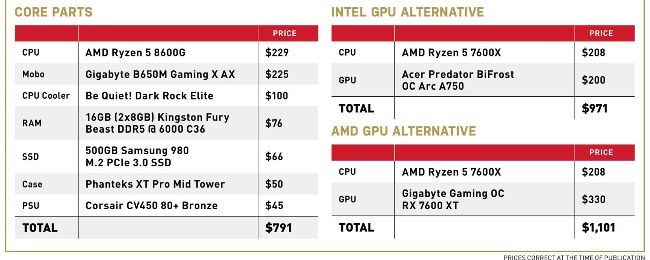
PRICES CORRECT AT THE TIME OF PUBLICATION
https://content.jwplatform.com/videos/mYuMeh0J-u2lN49He.mp4 Please type this URL into your browser if the link is broken
CORE HARDWARE PICKS
CPU
AMD Ryzen 5 8600G
$229, www.amd.com
AMD’s Ryzen series has, without a doubt, been an absolute hit. Its top-tier performance, incredible efficiency ratios, and stellar componentry has made it an absolute shoo-in for one of the best CPU architectures to date. It has pushed Intel’s own processors to the absolute limit from a competition front, and really helped AMD claw back even more market share.
The 8000 series, recently launched as an alternative to AMD’s Ryzen 7000 series desktop line, comes with dedicated iGPU componentry, specifically designed with gaming in mind. The 7000 line does have integrated graphics, utilizing two CUs pulled from the RDNA 2 GPU architecture, but it’s incredibly limited at a 2.2 GHz boost. The 8600 and 8700G, on the other hand, both benefit from eight and 12 CUs respectively of RDNA 3.0 (the same architecture found on the latest 7600 series GPUs and above), clocking up to 2.8 and 2.9 GHz.
In the other mainline specs, the 8600G packs in a total of six CPU cores, 12 threads, a maximum clock speed of 5 GHz, and 16MB of L3 cache on top. On the GPU side, you get eight CUs, featuring 512 shader cores, 32 TMUs, and 16 ROPs, and it even comes with 16 ray accelerators, as well as eight AI accelerators, giving it ray-tracing and AI upscaling capacity, too. It’s effectively 25 percent of an RX 7600, but with added CPU cores attached. The only downside is a lack of dedicated PCIe lanes for the GPU, as both chips only come with x8—not x16, as you’d find on the desktop.
SSD
500GB Samsung 980 M.2 PCIe 3.0 SSD
$66, www.samsung.com
It feels like an eternity since we’ve seen any new high-speed M.2 SSDs come out of the Samsung foundries, but that hasn’t stopped them developing some incredibly effective budget solutions. This is the Samsung 980. Nope, there’s no Evo or Pro branding here— just 500GBs of pure M.2 PCIe 3.0 performance.
Debuting in 2021, it’s a bit of a curious drive. It’s based off Samsung’s 128-layer TLC V-NAND, and features Samsung’s Pablo controller, all on the PCIe 3.0 platform. It also doesn’t have a traditional DDR cache, either, but instead uses an SLC buffer cache to amp up the speeds. It’s not a huge cache by any means, however, and the controller’s not great either. Once the cache is full, performance does tend to fall off a cliff a bit, so if you’re looking at transferring large data sets, this might not be the drive for you.
That said, it’s still a super-affordable budget PCIe 3.0 drive, capable of delivering up to 3.1 GB/s on sequential reads and 2.6 GB/s on sequential writes, and comes with a 300TBW endurance rating and your standard fiveyear warranty.
500GB isn’t a huge amount, but given we’re not exactly expecting our 8600G to be breaking frame-rate records in COD Warzone or World of
Warcraft, the games you’re likely to be playing should have smaller file sizes, anyway.
CPU Cooler
Be Quiet! Dark Rock Elite
$100, w w w.bequiet.com
We are going to preface this by saying that you do not need this cooler for this build. As standard, the Ryzen 5 8600G comes with AMD’s Wraith Stealth cooler (the 8700G comes with the Spire). The reason we’ve included it is that frustratingly, the Ryzen 5 7600X (our subbed dedicated GPU chip of choice) doesn’t come with a cooler out of the box. This is mildly annoying, considering it initially launched at an RRP of $300. I mean, yes we get it, it’s an X chip—that means overclocking, and to bring your own cooler, but again, it’s a budget price, at least chuck in a $20 unit, AMD?
Nonetheless, we’ve grabbed one heck of an air tower to keep those temperatures under control, no matter what, in the form of be quiet!’s Dark Rock Elite. This chunky unit comes with an intelligent mounting system, RGB, support for Intel and AMD, seven high-performance heat pipes, and twin 135mm Silent Wings PWM fans, as well as an on-board switch, allowing you to swap from quiet to performance mode, depending on your needs. It’s big, beefy, and more than enough to keep either of our chips cool under pressure.
RAM
16GB (2x8GB) Kingston Fury Beast DDR5 @ 6000 C36
$76, w w w.kingston.com
For memory, we’re actually keeping things quite simple in comparison to some of our other picks. The brief was simple—we know AMD’s Infinity Fabric improves performance considerably, and that its operating speed is tied to the clock speed that the memory controller is running at. We also know that both the 8600G and the 7600X are running off a single-core complex, so going above the memory sweet spot for speeds isn’t going to give us massive gains on the FPS performance for either chip.
With that in mind, and in an effort to keep pricing low (at the time we priced up this build, we hadn’t seen Corsair’s Vengeance 32GB kit drop to just $79), we grabbed one of the few 16GB kits that supported our 6000 MT/s
requirements at as low a price as possible, and here we are.