BEYOND MOORE’S LAW
Moore’s Law is mostly dead, yet it stumbles ominously forward. Jeremy Laird investigates whether the Lord of Light can revive computing’s prospects or are they already zombified?
© GETTY IMAHGES/JOHN SEATON CALLAHAN, WIKIMEDIA, INTEL, NVIDIA
MOORE’S LAW is dead. So says no less an authority on the subject than Nvidia CEO and leather jacket aficionado Jensen Huang (pictured below). Actually, Huang has been composing Moore’s Law’s obituary since at least 2017, when he expressed doubts over its long-term viability at the GPU Technology Conference in Beijing. Then at CES in 2019, Hunag unambiguously decreed “Moore’s Law isn’t possible anymore.”
It was last year during a Q&A to promote the then-hot new RTX 4090 GPU that Huang figuratively unloaded the final cap, simply saying “Moore’s Law is dead.” But here’s the thing. If you plot the transistor count of cutting-edge chips right up to the present day, it doesn’t seem like there’s been any slowdown in technological progress. But surely Huang knows what he is talking about?
Actually, Huang isn’t wrong. And yet transistor density in the latest chips is still increasing. You only have to glance at that logarithmic graph plotting transistor count progress since the 1970s to see that perfect straight line extends right up to today. So what, exactly, is going on?
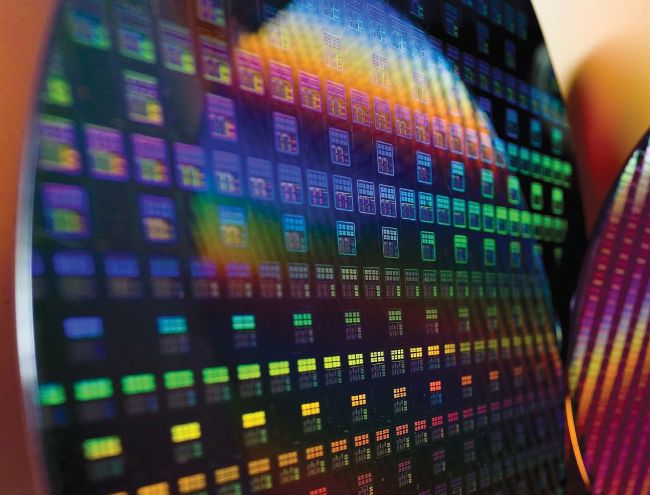
TSMC’s 3nm technology is painfully pricey.
LET’S BEGIN
with a tale of transistor counts. Specifically, in the 1970s, when transistor counts topped out at about 10,000 in a single chip. By the end of the 1980s, that count had exploded to about one million in the Intel 486 CPU. The late 1990s saw that increase to 50 million in the Pentium 4. The 2000s delivered 2.5 billion in an eight-core Nehalemclass Intel server CPU. And that RTX 4090 that Huang launched in 2022? The AD102 chip it uses packs about 75 billion of the tiny switches. And so the logarithmic increase in transistor density continues to this day.
Huang’s counter-analysis hinges on an often-overlooked aspect of Moore’s Law that involves cost. The standard exposition of Moore’s Law centers on the observation by Intel cofounder Gordon Moore that transistor densities were doubling every year back in the mid-1960s. Moore revised that down to doubling every two years in 1975. And that’s been the metric ever since.
Yet it misses out a key component of Moore’s observations as published in April 1965. They weren’t just about transistor density. Cost per component was also critical. Moore’s Law is as much about the cost of each transistor falling on the same logarithmic scale as it is about transistor density increasing. After all, if transistor density improves but the cost of each transistor doesn’t come down in proportion, you end up with the prospect of exponentially more powerful chips at exponentially higher prices. Which is of no use to anyone. And that’s where Huang’s latest comments come in.