GENESIS
Auntie knows best: the prog titans get a career-spanning, if incomplete, box set drawn from the Beeb’s archives.
Words: Sid Smith
Edited by Dave Everley prog.reviews@futurenet.com
Illustration: Mark Leary
For any serious band in the late 60s and 70s, securing a BBC Radio 1 session and having your songs fly through the nighttime airwaves into the ears of punters and record label executives alike was a crucial part of what was then known as ‘making it.’
BBC Broadcasts begins with sessions from 1970 to 1975, and continues via appearances at Knebworth in 1978 and 1992, 1980’s Lyceum gig, Wembley in 1987, and the Birmingham NEC in 1998. Across these five CDs (or three vinyl LPs), it’s possible to measure Genesis’ steady advance from cultish oddity to unlikely national treasure by the audience’s reaction as much as the music. During the previously unreleased performances of The Fountain Of Salmacis and The Musical Box at the BBC’s Paris Theatre from March 1972, the supporters are small in number but vocal for their underdog favourites. As their days of trundling around the motorways of Albion are put behind them, from 1975 onwards the roar of the stadiumsized crowds get loud enough to drown out the engines of a large jet, which is by then their regular city-hopping mode of transport when touring the USA. Once cap in hand for any crumbs that might fall from the BBC’s timetable, as the 1970s progressed into the 1980s and beyond, they were gifted radio and TV specials by Beeb producers as befits a band at the top of their commercial powers.
Early in their career, whether by design or accident, Genesis had a tendency to have the sharper edges apparent in concert somewhat softened on record. In the previously unreleased sessions for John Peel, Get ’Em Out By Friday, broadcast in November 1972, a month after Foxtrot’s release, Rutherford’s spiky and querulous bass spars with Collins’ vigorous drumming, and gives the polished studio version more than a good run for its money. The effect of the adrenaline-infused rush from playing live is especially evident on the third disc containing what is now the most complete version of their 1980 Lyceum gig.
"The effect of the adrenaline rush from playing live is evident."
After glow has a lively spring in the step, pulsing with a vitality that’s all but absent on the maudlin plod of its studio counterpart.
Throughout the post-Gabriel shows, Daryl Stuermer and Chester Thompson dig deep into the material to bring a lithe muscularity. Stuermer’s showcase solo on Firth Of Fifth during Old Medley simultaneously honours Steve Hackett’s sublime melodicism while adding a sprightly potency that slides beyond reverential reenactment. The same is true of that venerable warhorse The Knife, here deftly sharpened to a deadly 3’52” running time, indicating that brevity needn’t always mean compromising a song’s artistic integrity.
With Gabriel’s tenure represented by 11 tracks and Ray Wilson’s by just two, it’s Collins who rightly dominates this box. His growth from earnest muso to all-around entertainer is admirably illustrated. Whether it’s the crack of his thunderous double drumming during those excursions with Thompson, the crowd-pleasing extrovert tambourine-tossing antics, or gently traversing the emotional nuances of Say It’s Alright Joe, there’s never a moment when the crowd isn’t completely in the palm of his hand.
Of course, there is a “but” with the 53-track BBC Broadcasts. Some of it’s been previously released on Genesis Archive 1967-75 and though cherry-picking some of the previously unreleased tracks from Radio 1 sessions in 1972 is obviously welcome, the knowledge that other numbers have been left to languish in the Beeb’s vaults is immensely frustrating. Similar concerns apply to later performances known to exist.
If history is written by the winners, when it comes to curating a band’s narrative, the ‘winner’ will usually be the one member with the fortitude and forbearance required when revisiting the work of their younger selves. It’s common for musicians, when delving into their archive, to blanch or become queasy at the prospect of what they judge to be a subpar performance or questionable audio quality being immortalised through an official release. In this instance, it’s ultimately the decision of producer Nick Davis and Tony Banks as to what goes in and what gets left out.
However, hardcore fans, who will surely account for the vast bulk of potential sales, generally want the gig, the whole gig, and nothing but the gig, warts and all. The compilers might, not unreasonably, point out that this approach would result in a degree of repetition that defies common sense. It’s a rational enough argument of course but one that hardcore fans, who’d jump at the chance to compare and contrast those respective sessions, are unlikely to be comforted by. Had what was in the BBC’s archives been released in full this could have been The Complete BBC Broadcasts, and that would have made this absolutely indispensable rather than optional.
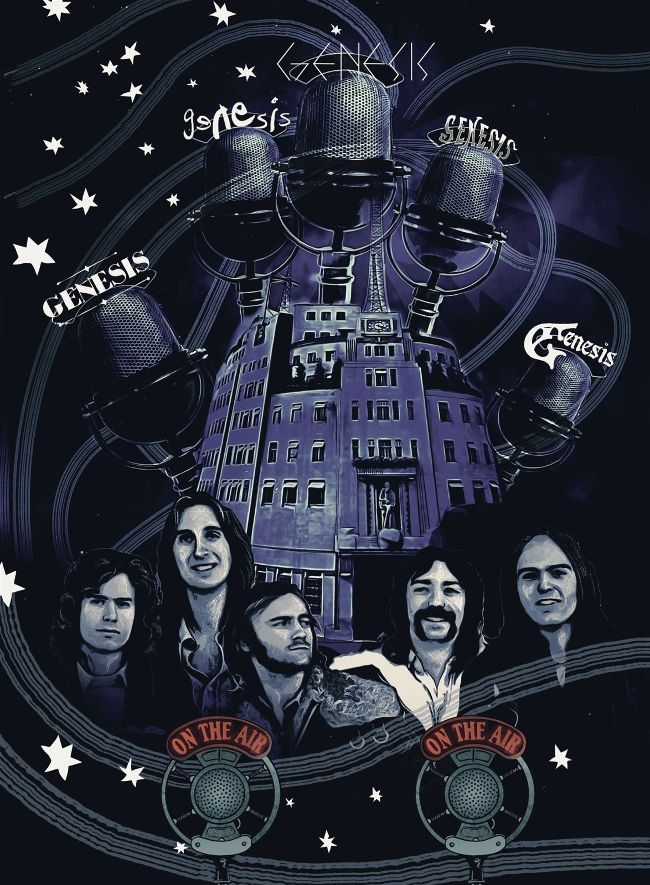
PHOTO SOURCE:MICHAEL OCHS ARCHIVES/GETTY IMAGES
EXPLORING BIRDSONG
Dancing In The Face Of Danger LONG BRANCH
Prog Award nominees finally deliver a second set of goods.
It’s probably fair to say that of all the great Liverpudlian trios who’ve covered (Don’t Fear) The Reaper and also written a song with Sir Paul McCartney, Exploring Birdsong are among those most likely to succeed. Prog first spotted them back in 2018, playing as if to thousands in a near-empty room above a pub in Camden, a year prior to the release of debut EP The Thing With Feathers. Located sonically somewhere between the classically inspired sparkle of Iamthemorning and Steven Wilson at his most bombastic, they made a noise much bigger than the sum of their parts, aided in no small part by bassist/keyboardist Jonny Knight and his ability to play both instruments at the same time.
“It’s taken a long time, but it’s an enticing, many-layered listen.
”
It may have taken a long time to get here, but follow-up EP Dancing In The Face Of Danger is an enticing, many-layered listen. Kicking off with a brief thunder of drums from Matt Harrison before launching into a stuttering riff, Pyre leaps about with cheery abandon, one idea swiftly consumed by the next, juddering sections followed by deft piano passages, vocals spiralling skywards and a rumbling bass line at the death that’s straight from Chris Squire school of fleet-fingered dexterity. The Way Down begins with a keyboard intro that could almost be a Rammstein cast-off, before a monumental guitar riff arrives, except it doesn’t because of course there’s no guitarist involved, though it never seems that this might be some sort of oversight. Exploring Birdsong paint with a lot of very bright colours despite their apparently limited palette.
Floating above, behind and beyond all this brushwork is singer and pianist Lynsey Ward, who shines most brightly on Bear The Weight, coming on like Kate Bush fronting Porcupine Tree as the other musicians crash and collide around her. Ever The Optimist – the song they wrote with McCartney, back when they were students at the Liverpool Institute Of Performing Arts, the college co-founded by the ex-Beatle – follows, and it takes another tack altogether, gently unwinding over wobbling synths before more guitars that aren’t actually guitars usher everything towards a giddy, frothing climax.
Last up is the EP’s longest song, No Longer We Lie, which packs an awful lot into less than the time it takes to boil an egg. It kicks off with a piano line that sounds like a more upbeat version of that bit from Tubular Bells that was used in The Exorcist, before spidering off into further territories, with string sections and crazy rhythms and possible choruses of angels. There’s a lot to like here.
FRASER
LEWRY
AISLES
Beyond Drama PRESAGIO Chilean sextet deliver album four with flair after six-year wait.
Following up their 2016 sprawling concept album, Hawaii – hailed by Prog as a “joyous expression of individuality” – was never going to be an easy feat. It seems Aisles have taken their time in crafting its successor.
With vocalist Israel Gil, who joined in 2020, at the helm, the band feel re-energised. It’s a shame, then, that the magic of this line-up is to be so short lived with Gil, guitarist Rodrigo Epúlveda and drummer Felipe Candia announcing their departure from the band in late January. The high energy of Fast unites modern prog rock with swinging salsa, while Megalomania
balances beautifully pained vocals with sugary hooks.
Needsun is thickly layered and tactfully cacophonous, while the extravagant, slow burning 11-minuter The
Plague is a contrast. It subtly nods to the founding fathers of prog without watering down Aisles’ uniqueness before instrumental Game
Over closes with new meaning. The record flaunts the group’s dexterity as songwriters wonderfully and has a wide, colourful appeal, yet is now a snapshot of what could have been. The remaining members can celebrate its success, albeit with the question of ‘what next?’ hanging overhead.
POW
DAVID BREWIS
The Soft Struggles DAYLIGHT SAVING RECORDS Field Music founder revels in baroque majesty on delightful solo album.
Best known for leading Sunderland art-rockers Field Music with brother Peter, David Brewis has also carved out an intriguing career with side-project School Of Language across three albums. With such a prodigious output behind him, it comes as something of a surprise that The Soft Struggles is his first fully fledged solo album.
What also raises eyebrows is the current direction taken by Brewis. While his side-project has found him moving in the area of mutant funk with music that twists this way and that, it’s here that he’s found his sweet spot. Eschewing hard rhythms, he’s accompanied by
Sarah Hayes (piano and flute) and Faye MacCalman (saxophone and clarinet) as well as the string quartet of Ed Cross, Jo Montgomery, Chrissie Slater and Ele Lecki and the result is an album of very English baroque pop.
While Surface Noise recalls the celtic folk-soul of Van Morrison’s Astral Weeks, the rest of the album nods to the tranquillity of Zombies’ vocalist Colin Blunstone’s 1971 solo offering, One Year, which serves to highlight Brewis’ tremulous voice and lyrical empathy (see Start Over). Best of all is The Last Day, which swells to a glorious climax. More please.
JMC
THE AARON CLIFT EXPERIMENT
The Age Of Misinformation
THEAARONCLIFTEXPERIMENT.BANDCAMP.COM Texan quartet search for the truth on album number four.
The challenges of the last few years have offered oodles of creative opportunity for songwriters out there, and the latest to have a crack are The Aaron Clift Experiment with their fourth album, The Age Of Misinformation. A document of the lockdown era, the US prog collective paradoxically continue to give their music the freedom to roam.
‘Born into a swarm of eyes, where hoaxes grow like thorns,’ vocalist and keyboardist Clift sings on the title track, on top of classic rock-meets-prog vigour. There’s a Rush whip to L.I.A.R, while the ethereal Color Of Flight
skews the norm and slides in sun-kissed acoustic guitar, strings and percussion, even if the pace occasionally drops and the album teeters on the edge of losing its verve – Rise drags, despite some incandescent harmonies.
The crowning glory is served up in Bet On Zero, a 10-minute odyssey featuring Big Wy’s Brass Band, which somehow manages to sneak in a drum solo mid-tune without feeling trite. Joyfully detouring into hookglazed, jazz fusion, it’s an exhilarating romp that shows why this Experiment should, well, experiment like this a little more often.
CC
MATT DORSEY
Let Go
MATTDORSEY1.BANDCAMP.COM
Pop-rock tunes from ex-Sound Of Contact multi-instrumentalist.
Having established himself in various other projects – namely, Sound Of Contact – it’s no shock that Matt Dorsey’s first solo LP, Let Go, is a diverse affair. Featuring contributions from Marco Minnemann and Dave Kerzner, standout Waiting For The Fall comes closest to evoking the sci-fi prog rock hooks and complexity Dorsey is most associated with. Contemplative opener Castles Made Of Sand recalls late-70s Genesis, whereas Man and Let Go lean closer to the cosmic keyboards and guitar-driven heft of Rush.
All of them do a superb job of fusing familiar genre elements with
Dorsey’s distinctive singersongwriter palette, yet the album is truly impressive when it veers into even fresher territories. The ballad Compromise is particularly catchy and uplifting, with gentle acoustic guitar and piano chords supporting vocal harmonies and modest percussion. Influences such as XTC and Peter Gabriel can be felt within Impossible
Friends’ sophisticated arrangements, while Echo borders on orchestral indie rock thanks to its bouncy rhythms and jubilant horns. Closer Dangerous is a bit bland, but it doesn’t stop Let Go from being an enjoyable listen.
JMB
ELECTROND
Uneasy Listening ELECTROND RECORDS Space madness from Norwegian progger’s spin-off project.
Electrond is the brainchild of Trond Gjellum, the drummer in Oslo prog bands Panzerpappa and Suburban Savages. For this electronic side-project, Gjellum taps into the universes of far-out composers, such as German avant-garde titans Conrad Schnitzler and the late Manuel Göttsching, bringing his own eccentricities to the party.
Onstage he assumes PPE clothing and covers his head and body like a post-apocalyptic lab technician. It’s in keeping with the extended EP’s title, although Uneasy Listening is a misnomer. Opener Apogee is stately,
like a numinous ballroom of the imagination, while
Cicada chimes with retrofuturist nostalgia. There’s a charming, almost ramshackle DIY element to all of these songs, bringing a tatterdemalion elegance that feels rather like a rocket ship lost in space, majestic yet ravaged by one meteor storm too many.